Latest Topics in News


Ramsar Sites in India: 103 Sites, State-wise List and Map
Ramsar sites in India are wetlands of international importance listed under the Ramsar Convention. India has 103 Ramsar sites in 28 states and union territories as of October 2026. Tamil Nadu has the most (20), followed by Uttar Pradesh (14).
How many Ramsar sites are there in India?
India has 103 Ramsar sites as of October 2026. Only the United Kingdom (176) and Mexico (144) have more, so India ranks 3rd in the world. The key facts are listed below.
- First sites: Chilika Lake (Odisha) and Keoladeo National Park (Rajasthan), listed on 1 October 1981.
- Largest site: Sundarban Wetland, West Bengal (4,23,000 ha).
- Smallest site: Vembannur Wetland Complex, Tamil Nadu (19.75 ha).
- Growth: 26 sites up to 2014, 80 sites in January 2024, 103 sites in October 2026.
- Indian law: Wetlands (Conservation and Management) Rules, 2017.
Which are the latest Ramsar sites in India?
The latest Ramsar sites in India are Sukhna Wetland (Chandigarh) and Sauj Jheel (Uttar Pradesh), announced on 15 October 2026. The 23 Ramsar sites added since February 2024 are listed below, newest first.
| India’s no. | Ramsar site | State/UT | Designation date |
|---|---|---|---|
| 103 | Sauj Jheel | Uttar Pradesh | 18 Jun 2026 |
| 102 | Sukhna Wetland | Chandigarh | 16 Mar 2026 |
| 101 | Glaw Lake | Arunachal Pradesh | 21 Jan 2026 |
| 100 | Jai Prakash Narayan Bird Sanctuary | Uttar Pradesh | 19 Jan 2026 |
| 99 | Sheikha Jheel Bird Sanctuary | Uttar Pradesh | 19 Jan 2026 |
| 98 | Patna Bird Sanctuary | Uttar Pradesh | 4 Dec 2025 |
| 97 | Chhari Dhand | Gujarat | 16 Jun 2025 |
| 96 | Kopra Jalashay | Chhattisgarh | 8 Aug 2025 |
| 95 | Siliserh Lake | Rajasthan | 7 Jul 2025 |
| 94 | Gogabil Lake | Bihar | 13 May 2025 |
| 93 | Udaipur Jheel | Bihar | 13 May 2025 |
| 92 | Gokul Jalashay | Bihar | 13 May 2025 |
| 91 | Khichan Wetland | Rajasthan | 19 Feb 2025 |
| 90 | Menar Wetland Complex | Rajasthan | 19 Feb 2025 |
| 89 | Therthangal Bird Sanctuary | Tamil Nadu | 15 Jul 2024 |
| 88 | Sakkarakottai Bird Sanctuary | Tamil Nadu | 15 Jul 2024 |
| 87 | Khachoedpalri Wetland | Sikkim | 15 Jul 2024 |
| 86 | Udhwa Lake Bird Sanctuary | Jharkhand | 8 Jan 2024 |
| 85 | Nanjarayan Bird Sanctuary | Tamil Nadu | 16 Jan 2024 |
| 84 | Kazhuveli Bird Sanctuary | Tamil Nadu | 16 Jan 2024 |
| 83 | Tawa Reservoir | Madhya Pradesh | 8 Jan 2024 |
| 82 | Nakti Bird Sanctuary | Bihar | 11 Oct 2023 |
| 81 | Nagi Bird Sanctuary | Bihar | 11 Oct 2023 |
Ramsar Sites in India Map
The Ramsar sites in India map marks all 103 sites by state and union territory.
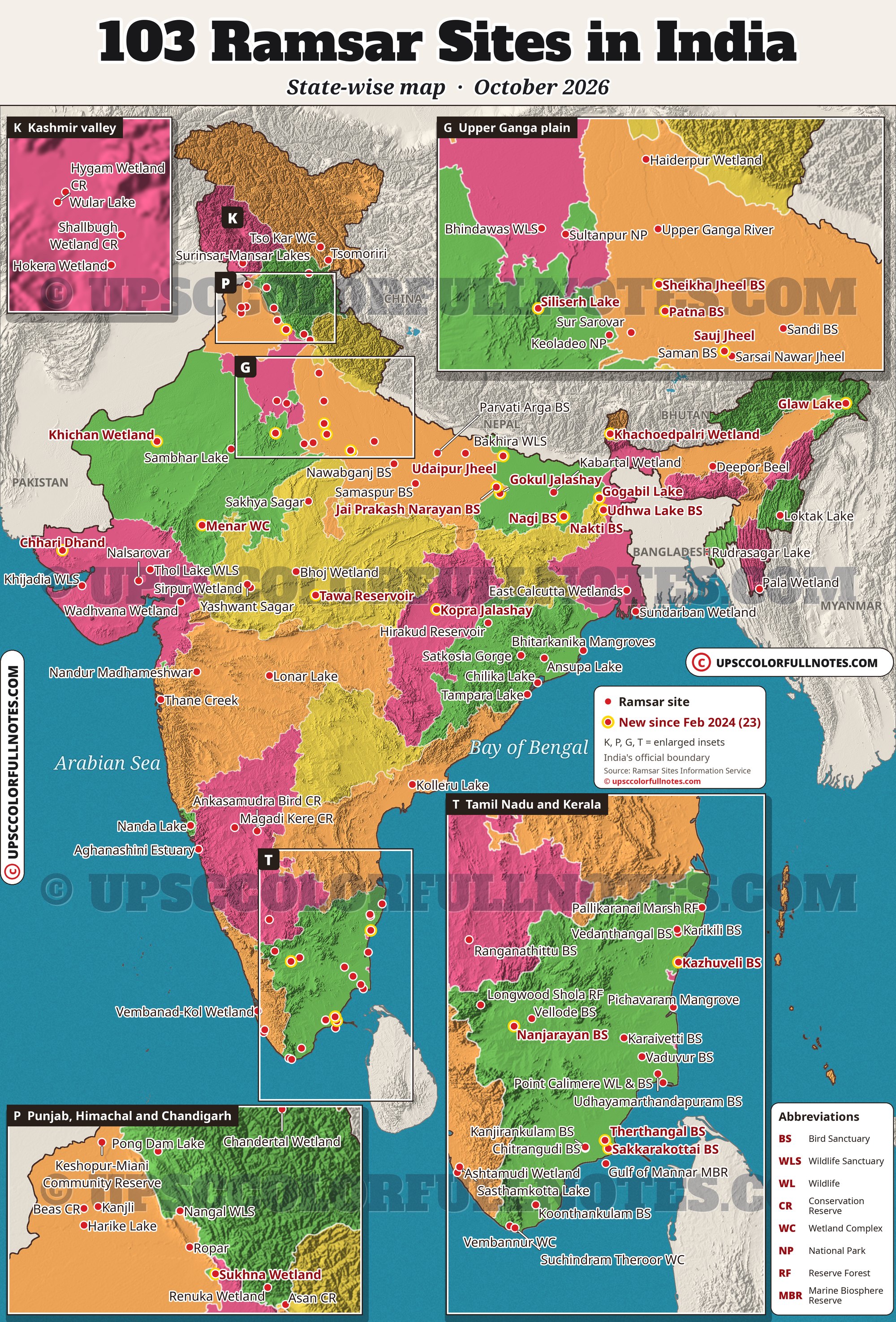
Download: 103 Ramsar sites in India map (HD JPG)
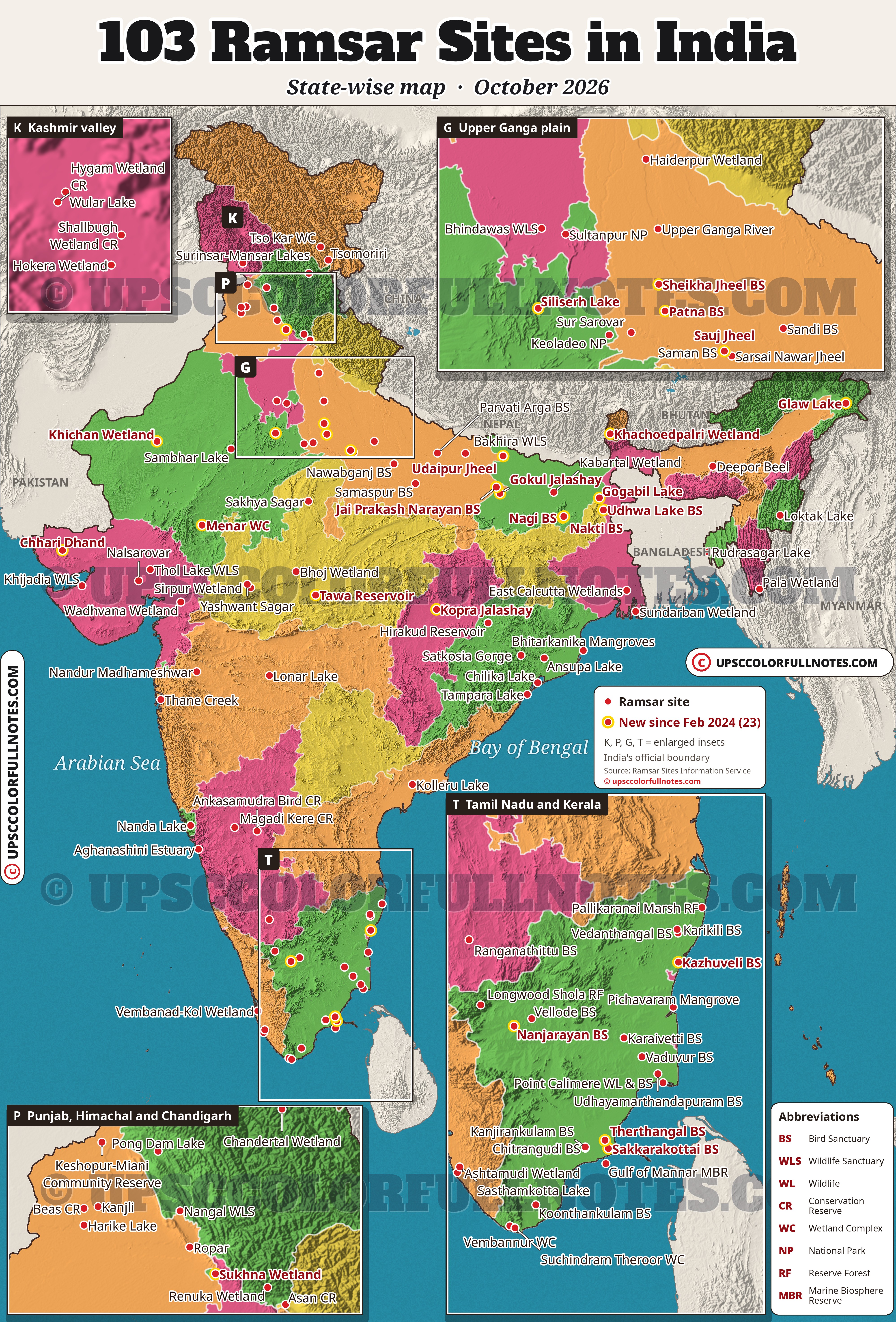
Which state has the most Ramsar sites in India?
Tamil Nadu has the most Ramsar sites in India (20), followed by Uttar Pradesh (14) and Odisha, Punjab and Bihar (6 each). The Ramsar site count of all 28 states and union territories is listed below.
| # | State/UT | Ramsar sites |
|---|---|---|
| 1 | Tamil Nadu | 20 |
| 2 | Uttar Pradesh | 14 |
| 3 | Bihar | 6 |
| 4 | Odisha | 6 |
| 5 | Punjab | 6 |
| 6 | Gujarat | 5 |
| 7 | Jammu and Kashmir | 5 |
| 8 | Madhya Pradesh | 5 |
| 9 | Rajasthan | 5 |
| 10 | Karnataka | 4 |
| 11 | Himachal Pradesh | 3 |
| 12 | Kerala | 3 |
| 13 | Maharashtra | 3 |
| 14 | Haryana | 2 |
| 15 | Ladakh | 2 |
| 16 | West Bengal | 2 |
| 17 | Andhra Pradesh | 1 |
| 18 | Arunachal Pradesh | 1 |
| 19 | Assam | 1 |
| 20 | Chandigarh | 1 |
| 21 | Chhattisgarh | 1 |
| 22 | Goa | 1 |
| 23 | Jharkhand | 1 |
| 24 | Manipur | 1 |
| 25 | Mizoram | 1 |
| 26 | Sikkim | 1 |
| 27 | Tripura | 1 |
| 28 | Uttarakhand | 1 |
Which are the Ramsar sites in Tamil Nadu?
Tamil Nadu has 20 Ramsar sites, the highest count of any state in India. Fourteen of the 20 are bird sanctuaries, and eleven of them were listed on a single day, 8 April 2022.

Download: Ramsar sites in Tamil Nadu map (HD JPG)
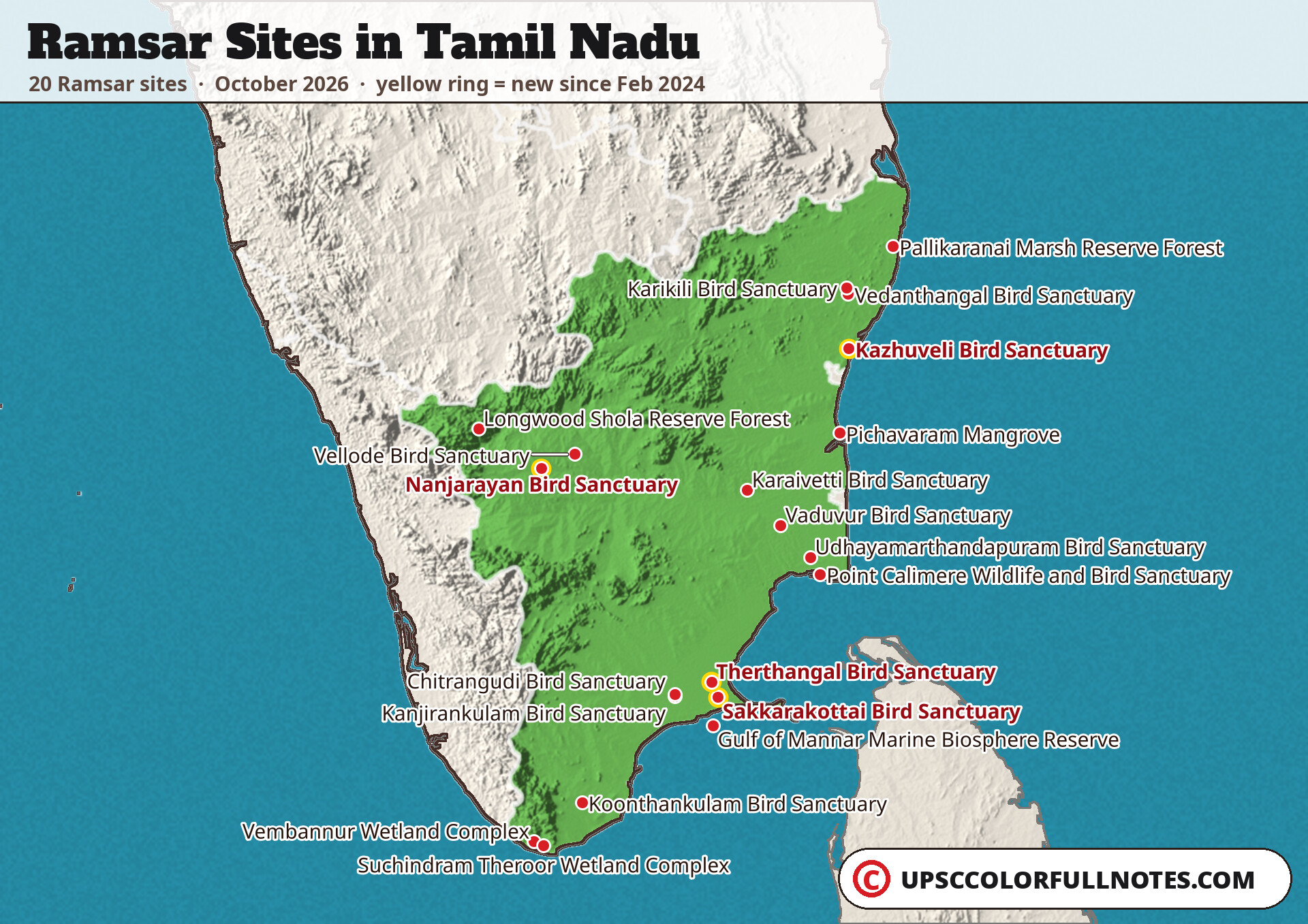
The 20 Ramsar sites of Tamil Nadu are listed below in order of designation.
| # | Ramsar site | Wetland type | Listed | Known for |
|---|---|---|---|---|
| 1 | Point Calimere Wildlife and Bird Sanctuary | Coastal lagoons, mudflats, mangrove | 2002 | 30,000 flamingos |
| 2 | Koonthankulam Bird Sanctuary | Canal-linked irrigation tanks | 2021 | Largest waterbird breeding reserve, South India |
| 3 | Chitrangudi Bird Sanctuary | Rain-fed village tank | 2021 | Spot-billed pelican breeding |
| 4 | Gulf of Mannar Marine Biosphere Reserve | Marine, coral, mangrove | 2022 | Dugong, 117 coral species |
| 5 | Vembannur Wetland Complex | Human-made irrigation tank | 2022 | India’s smallest Ramsar site |
| 6 | Vellode Bird Sanctuary | Human-made tank | 2022 | Central Asian Flyway breeding |
| 7 | Udhayamarthandapuram Bird Sanctuary | Canal-linked irrigation tanks | 2022 | Fed by Mettur dam |
| 8 | Vedanthangal Bird Sanctuary | Small irrigation tank | 2022 | Nature tourism, painted stork |
| 9 | Karikili Bird Sanctuary | Two rain-fed tanks | 2022 | Oriental darter breeding |
| 10 | Pallikaranai Marsh Reserve Forest | Freshwater, partly saline marsh | 2022 | Chennai’s flood buffer |
| 11 | Pichavaram Mangrove | Mangrove forest | 2022 | Hybrid mangrove, olive ridley |
| 12 | Kanjirankulam Bird Sanctuary | Babul-wooded tank | 2022 | Migratory heron nesting |
| 13 | Suchindram Theroor Wetland Complex | Two man-made reservoirs | 2022 | Southern tip, Central Asian Flyway |
| 14 | Vaduvur Bird Sanctuary | Canal-linked reservoirs | 2022 | 118 bird species |
| 15 | Karaivetti Bird Sanctuary | Inland freshwater lake | 2023 | 10,000 nesting waterbirds |
| 16 | Longwood Shola Reserve Forest | Marshes inside shola forest | 2023 | Nilgiri endemic birds |
| 17 | Kazhuveli Bird Sanctuary | Brackish lake | 2024 | 229 bird species |
| 18 | Nanjarayan Bird Sanctuary | 400-year-old reservoir | 2024 | 191 bird species |
| 19 | Sakkarakottai Bird Sanctuary | Peri-urban tank | 2024 | 120+ bird species |
| 20 | Therthangal Bird Sanctuary | Marshy lake | 2024 | Egyptian vulture |
1. Point Calimere Wildlife and Bird Sanctuary
Point Calimere Wildlife and Bird Sanctuary is a coastal wetland on the Tamil Nadu coast, with sand bars, mudflats, mangrove, saline lagoons and salt works.
- Listed: 19 August 2002, area 38,500 ha.
- Birds: some 257 bird species, 119 of them waterbirds, with some 30,000 greater and lesser flamingos.
- Wildlife: the vulnerable spoonbill sandpiper and grey pelican are recorded here; the shallows are a nursery for fish, prawns and crabs.
- Threats: firewood collection, spread of Chilean mesquite, brackish groundwater from the salt works, and falling freshwater inflow.
2. Koonthankulam Bird Sanctuary
Koonthankulam Bird Sanctuary is a group of irrigation tanks in southern Tamil Nadu, linked by canals built a few centuries ago.
- Listed: 8 November 2021, area 72.0 ha.
- Birds: the largest reserve for breeding resident and migratory waterbirds in South India, on the Central Asian Flyway.
- Water source: rivers rising in the Western Ghats, with seasonal monsoon rain as the only other supply.
- Threats: encroachment, household sewage, urban wastewater and the growth of shrimp farms.
3. Chitrangudi Bird Sanctuary
Chitrangudi Bird Sanctuary is a rain-fed village tank in southern Tamil Nadu, protected since 1989 and locally called “Chitrangudi Kanmoli”.
- Listed: 8 November 2021, area 260.5 ha.
- Birds: 50 bird species, four of them near-threatened; spot-billed pelican, painted stork, little egret and grey heron breed here.
- Plants: medicinal plants such as holy basil and flame lily, the State flower of Tamil Nadu.
- Nearby site: Chitrangudi lies next to Kanjirankulam Bird Sanctuary, another Ramsar site.
4. Gulf of Mannar Marine Biosphere Reserve
Gulf of Mannar Marine Biosphere Reserve is a marine wetland at the south-eastern tip of India, where the Bay of Bengal meets the Indian Ocean.
- Listed: 8 April 2022, area 52,671.9 ha, the largest Ramsar site in Tamil Nadu.
- Wildlife: 117 coral species, over 450 fish including four seahorses, 160 birds, 641 crustaceans, four sea turtles and 11 mangroves.
- Threatened species: dugong, whale shark, green sea turtle, hawksbill turtle and Indo-Pacific humpback dolphin.
- Exam point: the first Marine Biosphere Reserve in South and South-East Asia.
5. Vembannur Wetland Complex
Vembannur Wetland Complex is a human-made irrigation tank a few kilometres inland from the southernmost point of mainland India, in Tamil Nadu.
- Listed: 8 April 2022.
- Birds: Indian river tern, spotted greenshank, garganey and grey pelican use the tank in breeding and non-breeding seasons.
- People: the tank waters more than 2,000 ha of farmland on which more than 1,000 families depend.
- Exam point: India’s smallest Ramsar site (19.75 ha); Renuka Wetland (20 ha) is next.
6. Vellode Bird Sanctuary
Vellode Bird Sanctuary is a human-made tank in Tamil Nadu, fed with food for birds by the farm fields around it.
- Listed: 8 April 2022, area 77.2 ha.
- Birds: a staging and breeding ground on the Central Asian Flyway; Indian river tern, oriental darter and painted stork nest here.
- People: farmers in fringe villages get higher yields because bird droppings enrich the irrigation water.
- Threats: household sewage, urban wastewater, vegetation clearance, land conversion and invasive non-native species.
7. Udhayamarthandapuram Bird Sanctuary
Udhayamarthandapuram Bird Sanctuary is a set of human-made irrigation tanks in Tamil Nadu, linked by an ancient canal network.
- Listed: 8 April 2022, area 43.8 ha.
- Birds: oriental darter, black-headed ibis, Eurasian wigeon, northern pintail and garganey stage and breed here.
- Water source: the Mettur dam, through the Koraiyar canal.
- Threats: storms, flooding, uncontrolled harvesting of aquatic resources, and tourism.
8. Vedanthangal Bird Sanctuary
Vedanthangal Bird Sanctuary is a small irrigation tank in Tamil Nadu, surrounded by rocky plains and low bare hillocks.
- Listed: 8 April 2022, area 40.3 ha; a Bird Sanctuary since 1998.
- Birds: black-headed ibis, Eurasian spoonbill, black-crowned night heron and painted stork make it an Important Bird and Biodiversity Area.
- People: nature tourism brings considerable income to local communities.
- Threats: housing and uncontrolled harvesting of aquatic resources.
9. Karikili Bird Sanctuary
Karikili Bird Sanctuary is a pair of rain-fed, non-perennial irrigation tanks in Tamil Nadu, lying near low rocky hillocks.
- Listed: 8 April 2022, area 58.4 ha; a Bird Sanctuary since 1972.
- Birds: the near-threatened oriental darter and spot-billed pelican breed here among planted Barringtonia and babul trees.
- Wildlife: jungle cat, bonnet macaque, jackal, python, sand boa and frogs.
- Water source: rainfall of 400 mm to almost 1,700 mm a year, flooding the tanks from July to September.
10. Pallikaranai Marsh Reserve Forest
Pallikaranai Marsh Reserve Forest is a freshwater and partly saline marsh about 20 km south of Chennai, in Tamil Nadu.
- Listed: 8 April 2022, area 1,247.5 ha.
- Wildlife: some 115 bird species, ten mammals, 21 reptiles, ten amphibians, 46 fish, nine molluscs, five crustaceans and seven butterflies.
- Birds: glossy ibis, grey-headed lapwing and pheasant-tailed jacana; Russell’s viper lives in the marsh.
- Flood control: the marsh soaks up floodwater for Chennai in wet spells and releases it in dry spells.
- Read more: Pallikaranai Marshland in Chennai.
11. Pichavaram Mangrove
Pichavaram Mangrove is one of the largest mangrove ecosystems in India, lying between the estuaries of the Vellar and Coleroon rivers in Tamil Nadu.
- Listed: 8 April 2022, area 1,478.6 ha; a Reserve Forest since 1893.
- Wildlife: the critically endangered great white-bellied heron and spoon-billed sandpiper, the endangered spotted greenshank, and the vulnerable olive ridley turtle.
- Plants: a natural hybrid mangrove grows here, and the toxic “Tillai” mangrove holds spiritual value for local people.
- People: over 1,000 families live by fishing, firewood, forest produce and grazing; the mangroves are a nursery for white and tiger prawns.
12. Kanjirankulam Bird Sanctuary
Kanjirankulam Bird Sanctuary is a babul-wooded wetland in southern Tamil Nadu, known as a nesting site for migratory herons.
- Listed: 8 April 2022, area 96.9 ha.
- Birds: near-threatened painted stork, spot-billed pelican, oriental darter and oriental white ibis nest in the babul trees.
- Threats: invasive Prosopis trees are crowding out the native babul; water levels swing with the climate.
- Nearby site: Kanjirankulam lies next to Chitrangudi Bird Sanctuary.
13. Suchindram Theroor Wetland Complex
Suchindram Theroor Wetland Complex is a pair of man-made reservoirs, Theroor and Suchindram, at the southern tip of Tamil Nadu and of the Central Asian Flyway.
- Listed: 8 April 2022, area 94.2 ha; part of the Suchindram-Theroor Manakudi Conservation Reserve.
- Birds: around 250 bird species, of which 53 are migratory, 12 endemic and four threatened.
- Water source: the Kodaiyar river system, releasing water stored in the Perunchanidam, Pechipparai and Kodaiyar reservoirs.
- People: the irrigation system dates from the ninth century and supports about 75% of the local population.
14. Vaduvur Bird Sanctuary
Vaduvur Bird Sanctuary is a group of small man-made reservoirs in the Kaveri delta region of Tamil Nadu, linked by ancient canals.
- Listed: 8 April 2022, area 112.6 ha.
- Birds: around 118 bird species, including spot-billed pelican, black-headed ibis, Eurasian wigeon and northern pintail.
- Water source: the Mettur reservoir.
- Threats: urbanisation, water abstraction, unsustainable fishing, invasive species and climate change.
15. Karaivetti Bird Sanctuary
Karaivetti Bird Sanctuary is one of the largest inland freshwater lakes in Tamil Nadu and a stopover on the Central Asian Flyway.
- Listed: 24 May 2023, area 453.7 ha.
- Birds: some 10,000 individuals of 14 colonial waterbird species nest here; spotted eagle, tawny eagle and Indian darter roost in the babul trees.
- Wildlife: the vulnerable Indian flap-shelled turtle breeds here; the vulnerable bonnet macaque causes human-wildlife conflict.
- Water source: the Mettur Dam keeps the lake filled from July to October, and the lake irrigates about 4,000 ha of farmland.
16. Longwood Shola Reserve Forest
Longwood Shola Reserve Forest is a set of marshes and streams inside a shola forest on the eastern slopes of the Nilgiri hills of Tamil Nadu.
- Listed: 24 May 2023, area 116.0 ha.
- Wildlife: around 40 tree species, four reptiles, 14 frogs and 14 birds endemic to the Western Ghats.
- Birds: the endangered black-chinned Nilgiri laughing thrush, the Nilgiri blue robin and the vulnerable Nilgiri wood-pigeon.
- Threats: encroachment, invasive species and deforestation; the forest is the only natural shola left near the town of Kothagiri.
17. Kazhuveli Bird Sanctuary
Kazhuveli Bird Sanctuary is the second largest brackish lake in Peninsular India, on the Tamil Nadu coast, and a Bird Sanctuary since 2021.
- Listed: 16 January 2024, area 5,151.6 ha.
- Birds: 229 bird species; over 2,000 colonial nesting birds each season, mainly spot-billed pelican; vulnerable spotted eagle and imperial eagle feed here.
- Wildlife: 85 fish, 72 butterflies, 39 reptiles, 13 amphibians and 14 mammals, with the vulnerable Indian flap-shelled turtle and Indian star tortoise.
- Salinity: Uppukalli creek links the lake to the Bay of Bengal in the north, so the water is salty in the north and fresh in the south.
18. Nanjarayan Bird Sanctuary
Nanjarayan Bird Sanctuary is a freshwater lake in western Tamil Nadu, a reservoir built 400 years ago by King Nanjarayan.
- Listed: 16 January 2024, area 125.9 ha; a Bird Sanctuary since 2022.
- Birds: 191 bird species; Indian darter and Indian cormorant nest in gum arabic trees on the bunds.
- Wildlife: 87 butterflies, 77 plants, 21 reptiles, 11 small mammals and 7 amphibians; the Indian flapshell turtle breeds on the banks.
- Water source: rainfall and run-off from the catchment and the Nallar River.
19. Sakkarakottai Bird Sanctuary
Sakkarakottai Bird Sanctuary is a peri-urban wetland spread over three villages in southern Tamil Nadu, a bird sanctuary since 2012.
- Listed: 15 July 2024, area 230.5 ha.
- Birds: more than 120 bird species; babul trees give nesting space to eight species, including the near-threatened spot-billed pelican.
- People: villagers use the bird-dropping-enriched water for farming, which keeps them supportive of bird protection.
20. Therthangal Bird Sanctuary
Therthangal Bird Sanctuary is a marshy lake in Therthangal village of southern Tamil Nadu, fed by two rivers in the rainy season.
- Listed: 15 July 2024, area 29.3 ha; a bird sanctuary since 2010.
- Birds: 96 bird species, including the endangered Egyptian vulture and the vulnerable Indian spotted eagle.
- Wildlife: 133 plant, 57 butterfly, 11 reptile, seven mammal and six amphibian species.
- People: the lake mainly irrigates fields in nearby villages and draws some tourism.
Which are the Ramsar sites in Uttar Pradesh?
Uttar Pradesh has 14 Ramsar sites, the second-highest count in India after Tamil Nadu. All 14 sites lie in the Ganga plain. Thirteen are lakes, marshes or reservoirs, and one is a stretch of the Ganga river.

Download: Ramsar sites in Uttar Pradesh map (HD JPG)
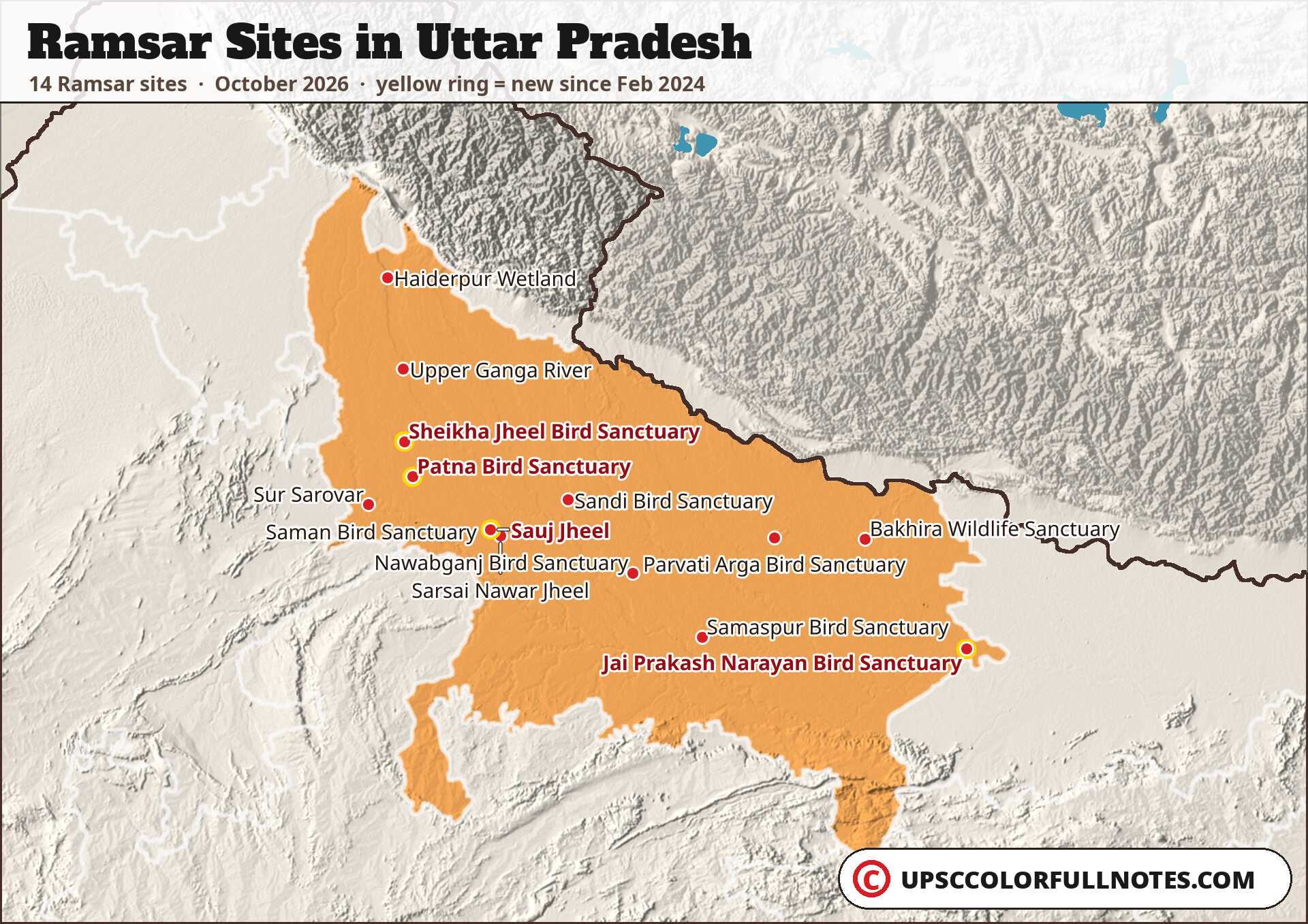
The 14 Ramsar sites of Uttar Pradesh are listed below in order of designation.
| # | Ramsar site | Wetland type | Listed | Known for |
|---|---|---|---|---|
| 1 | Upper Ganga River | River stretch (Brijghat–Narora) | 2005 | Ganges river dolphin, gharial |
| 2 | Sarsai Nawar Jheel | Permanent marsh | 2019 | 400 sarus cranes |
| 3 | Nawabganj Bird Sanctuary | Shallow marsh | 2019 | 25,000 waterbirds |
| 4 | Sandi Bird Sanctuary | Freshwater marsh | 2019 | 40,000+ waterfowl (2018 count) |
| 5 | Samaspur Bird Sanctuary | Six connected lakes | 2019 | 75,000+ birds |
| 6 | Saman Bird Sanctuary | Seasonal oxbow lake | 2019 | Greylag goose |
| 7 | Parvati Arga Bird Sanctuary | Two oxbow lakes | 2019 | Vultures |
| 8 | Sur Sarovar | Human-made reservoir | 2020 | Central Asian Flyway birds |
| 9 | Haiderpur Wetland | Human-made barrage wetland | 2021 | Gharial |
| 10 | Bakhira Wildlife Sanctuary | Floodplain marsh | 2021 | Wintering migrants |
| 11 | Patna Bird Sanctuary | Marsh, woodland, grassland | 2025 | 178 bird species |
| 12 | Sheikha Jheel Bird Sanctuary | Partly human-made lake | 2026 | Indian river tern |
| 13 | Jai Prakash Narayan Bird Sanctuary | Old Ganga meander | 2026 | India’s 100th Ramsar site |
| 14 | Sauj Jheel | Shallow seasonal lake | 2026 | 30,000+ waterbirds |
1. Upper Ganga River
Upper Ganga River is the Brijghat–Narora stretch of the Ganga and the largest Ramsar site in Uttar Pradesh (26,590 ha).
- Listed: 8 November 2005.
- Wildlife: Ganges river dolphin, gharial, 6 turtle species and 82 fish species.
- Threats: sewage discharge, farm run-off and intensive fishing.
2. Sarsai Nawar Jheel
Sarsai Nawar Jheel is a permanent marsh of the Indo-Gangetic floodplain in Uttar Pradesh, fed by run-off from the south-west monsoon.
- Listed: 19 September 2019, area 161.3 ha.
- Birds: 400 sarus cranes form the largest flock in the region, and the site takes its name from this crane.
- Wildlife: the critically endangered white-rumped vulture and the endangered woolly-necked stork are present.
- Threats: droughts and drainage.
3. Nawabganj Bird Sanctuary
Nawabganj Bird Sanctuary is a shallow marsh 45 kilometres from Lucknow in Uttar Pradesh, fed by monsoon rain and the Sarda Canal.
- Listed: 19 September 2019, area 224.6 ha.
- Birds: 25,000 waterbirds regularly recorded and 220 resident and migratory species, including the endangered Egyptian vulture.
- Wildlife: golden jackal and jungle cat returned after protection and afforestation measures.
- Threats: common water hyacinth, an invasive plant, and removal of timber from the forests.
4. Sandi Bird Sanctuary
Sandi Bird Sanctuary is a freshwater marsh of the Indo-Gangetic plains in Uttar Pradesh that receives most of its water from monsoon rain.
- Listed: 26 September 2019, area 308.5 ha.
- Birds: over 40,000 waterfowl counted in 2018, and 200 sarus cranes live inside the Sanctuary.
- Winter role: over 1 % of the South Asian populations of common teal, red-crested pochard and ferruginous duck.
- Threats: drought; the Sanctuary dried out and waterbird numbers collapsed from 2014 to 2015.
5. Samaspur Bird Sanctuary
Samaspur Bird Sanctuary is a perennial lowland marsh of six connected lakes in the Indo-Gangetic plain of Uttar Pradesh.
- Listed: 3 October 2019, area 799.4 ha.
- Birds: more than 75,000 birds in annual counts and over 250 species, including the endangered Egyptian vulture and Pallas’s fish eagle.
- Fish: at least 46 freshwater fish species, some migrating in from nearby rivers during monsoon floods.
- Threats: invasive plants; over 40 % of the recorded plant species are exotic.
6. Saman Bird Sanctuary
Saman Bird Sanctuary is a seasonal oxbow lake on the Ganga floodplain of Uttar Pradesh. Monsoon rain in July and August fills it.
- Listed: 2 December 2019, area 526.3 ha.
- Birds: more than 50,000 waterbirds and 187 bird species.
- Winter role: more than 1 % of South Asia’s greylag geese spend the winter at Saman.
7. Parvati Arga Bird Sanctuary
Parvati Arga Bird Sanctuary is a permanent freshwater wetland of two oxbow lakes in Uttar Pradesh.
- Listed: 2 December 2019, area 722 ha.
- Birds: over 100,000 birds in annual counts use the lakes for roosting and breeding.
- Wildlife: three threatened vultures recorded: the critically endangered white-rumped vulture and Indian vulture, and the endangered Egyptian vulture.
- Threats: common water hyacinth and the building of roads and railways.
8. Sur Sarovar
Sur Sarovar (Keetham Lake) is a human-made reservoir near Agra, built to supply the city with water in summer.
- Listed: 21 August 2020, area 431 ha.
- Birds: more than 30,000 waterbirds a year on the Central Asian Flyway.
- Fish: more than 60 fish species, including the vulnerable catfish Wallago attu.
- Exam point: human-made wetlands like Sur Sarovar qualify as Ramsar sites.
9. Haiderpur Wetland
Haiderpur Wetland is a human-made wetland on the Ganga floodplain of Uttar Pradesh, formed in 1984 by the Madhya Ganga Barrage.
- Listed: 13 April 2021, area 6,908 ha.
- Wildlife: over 300 bird species, more than 40 fish and more than ten mammal species, including the critically endangered gharial.
- Birds: more than 25,000 waterbirds, with over 1 % of the greylag goose and bar-headed goose populations.
- Location: the wetland lies inside Hastinapur Wildlife Sanctuary.
10. Bakhira Wildlife Sanctuary
Bakhira Wildlife Sanctuary is a freshwater marsh and the largest natural floodplain wetland of eastern Uttar Pradesh.
- Listed: 29 June 2021, area 2,894 ha; the Sanctuary was set up in 1980.
- Birds: over 80 species, with over 25 wintering migrants of the Central Asian Flyway, including the endangered Egyptian vulture.
- Fish: 45 species, including the vulnerable European carp and the catfish Wallago attu.
- Plants: 119 plant species.
11. Patna Bird Sanctuary
Patna Bird Sanctuary is a mix of freshwater marsh, woodland and grassland surrounded by farmland in Uttar Pradesh.
- Listed: 4 December 2025, area 108.9 ha.
- Birds: 178 bird species; the site is an Important Bird and Biodiversity Area.
- Wildlife: 252 plant species and the vulnerable broad-snouted crocodile.
- Threats: pressure from religious tourism and recreation, and invasive species.
12. Sheikha Jheel Bird Sanctuary
Sheikha Jheel Bird Sanctuary is a partly human-made lake and forest in Uttar Pradesh, formed after the Upper Ganges Canal was built in the 1850s.
- Listed: 19 January 2026, area 40.3 ha.
- Birds: 249 species, of which 62 depend on the wetland, including the vulnerable Indian river tern and sarus crane.
- Wildlife: three threatened turtles: black pond turtle, Indian flap-shelled turtle and Ganges soft-shelled turtle.
- Location: the Upper Ganges Canal flows next to the site.
13. Jai Prakash Narayan Bird Sanctuary
Jai Prakash Narayan Bird Sanctuary is a freshwater wetland formed from an old meander of the Ganga in Uttar Pradesh, fed by three channels.
- Listed: 19 January 2026, India’s 100th Ramsar site, area 3,432 ha.
- Birds: a summer refuge for waterbirds when smaller wetlands dry out, including the vulnerable common pochard and Indian river tern.
- Wildlife: 221 plant species, 66 fish species, seven reptiles and three amphibians; the vulnerable fishing cat feeds here.
- Exam point: Jai Prakash Narayan Bird Sanctuary is India’s 100th Ramsar site.
14. Sauj Jheel
Sauj Jheel is a shallow lake in the Ganga floodplain of Uttar Pradesh and India’s 103rd Ramsar site.
- Listed: 18 June 2026, Ramsar site no. 2603, announced on 15 October 2026.
- Area: 40.8 ha, the 6th-smallest Ramsar site in India.
- Birds: more than 30,000 waterbirds regularly, including the sarus crane and the greater spotted eagle.
- Nearby site: Sauj Jheel lies next to Saman Bird Sanctuary, a Ramsar site since 2019.
Which are the Ramsar sites in Bihar?
Bihar has 6 Ramsar sites. Three of the six are oxbow lakes, all listed on the same day in May 2025, and two are dam wetlands listed together in October 2023.

Download: Ramsar sites in Bihar map (HD JPG)
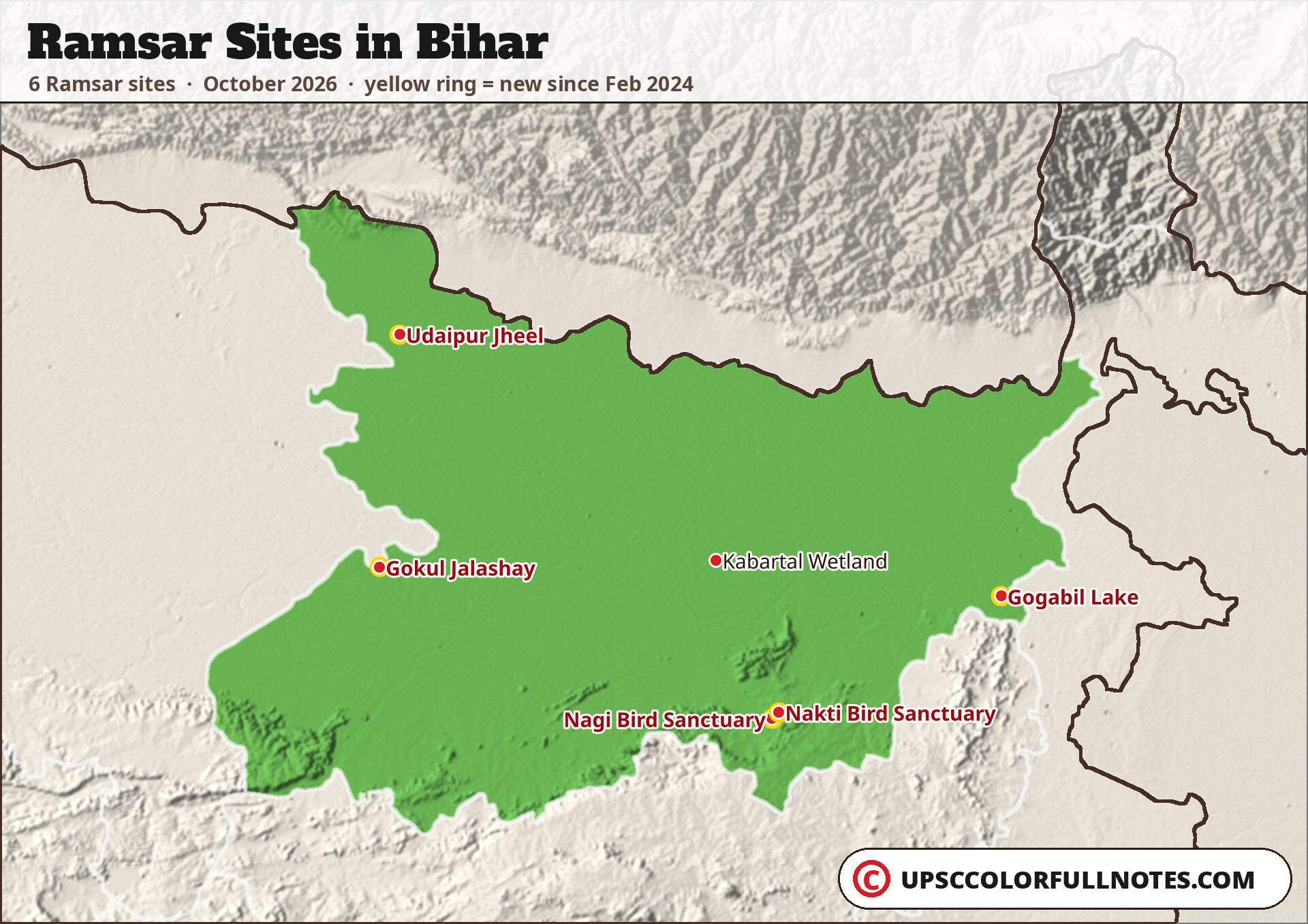
The 6 Ramsar sites of Bihar are listed below in order of designation.
| # | Ramsar site | Wetland type | Listed | Known for |
|---|---|---|---|---|
| 1 | Kabartal Wetland | Floodplain wetland | 2020 | PYQ 2023, Burhi Gandak |
| 2 | Nagi Bird Sanctuary | Dammed river wetland | 2023 | Bar-headed goose |
| 3 | Nakti Bird Sanctuary | Irrigation reservoir | 2023 | Red-crested pochard |
| 4 | Gokul Jalashay | Oxbow lake | 2025 | Ganga flood buffer |
| 5 | Udaipur Jheel | Oxbow lake | 2025 | 280 plant species |
| 6 | Gogabil Lake | Oxbow lake | 2025 | Bihar’s first Community Reserve |
1. Kabartal Wetland
Kabartal Wetland (Kanwar Jheel) is a floodplain wetland of the Indo-Gangetic plains in northern Bihar, one of 18 wetlands in one flood complex.
- Listed: 21 July 2020, area 2,620 ha; the wetland floods to 1.5 metres in the monsoon.
- Wildlife: 165 plant species and 394 animal species, including 221 bird species and over 50 fish species.
- Birds: a Central Asian Flyway stopover for 58 migratory waterbirds; five critically endangered species include three vultures, sociable lapwing and Baer’s pochard.
- Exam point: UPSC Prelims 2023 asked about it as Kanwar Lake; it is linked to the Burhi Gandak, not the Gandak.
- Read more: Kanwar Lake in Bihar.
2. Nagi Bird Sanctuary
Nagi Bird Sanctuary is a wetland in Bihar formed by damming the Nagi River, with a catchment of dry deciduous forest ringed by hills.
- Listed: 11 October 2023, area 205.8 ha; a Bird Sanctuary since 1984.
- Birds: over 75 bird species, with one of the largest gatherings of bar-headed goose on the Indo-Gangetic plain.
- Wildlife: the critically endangered Baer’s pochard and the endangered steppe eagle winter here; 33 fish and 12 aquatic plants.
- Irrigation: the wetland waters over 9,800 acres of farmland.
3. Nakti Bird Sanctuary
Nakti Bird Sanctuary is a human-made wetland in Bihar created by Nakti Dam for irrigation, with hills around its forest catchment.
- Listed: 11 October 2023, area 332.6 ha; a Bird Sanctuary since 1984.
- Birds: over 20,000 birds gather in winter, with one of the largest gatherings of red-crested pochard on the Indo-Gangetic plain.
- Wildlife: over 150 species in all, including the endangered Indian elephant and the vulnerable catfish Wallago attu.
- Nearby site: Nagi and Nakti are twin dam wetlands listed on the same day.
4. Gokul Jalashay
Gokul Jalashay is an oxbow lake on the southern edge of the Ganga in Bihar.
- Listed: 13 May 2025, area 448 ha.
- Birds: over 50 bird species in the site and its surroundings.
- Water source: Ganga flood pulses; the lake buffers nearby villages during floods.
- Community: villagers remove weeds and clean the catchment together each year during a traditional festival.
5. Udaipur Jheel
Udaipur Jheel is an oxbow lake in Bihar bordered on the north and west by the forest of Udaipur Wildlife Sanctuary.
- Listed: 13 May 2025, area 319 ha.
- Plants: over 280 plant species, including a perennial herb endemic to India; jamun trees line the lake.
- Birds: a wintering ground for around 35 migratory species, including the vulnerable common pochard.
- Threats: illegal fishing and chemical fertilizers and pesticides from intensive farming.
6. Gogabil Lake
Gogabil Lake is an oxbow wetland in Bihar lying between the Ganga and the Mahananda rivers, which it joins during floods.
- Listed: 13 May 2025, area 86.6 ha.
- Community: Bihar’s first “Community Reserve”, conserved and managed by the local community.
- Birds: a Central Asian Flyway wintering ground, including the vulnerable common pochard; an Important Bird and Biodiversity Area.
- Fish: the vulnerable catfish Wallago attu breeds here.
Which are the Ramsar sites in Odisha?
Odisha has 6 Ramsar sites. Four of the six were listed on one day, 12 October 2021, including Hirakud Reservoir and Satkosia Gorge on the Mahanadi river.

Download: Ramsar sites in Odisha map (HD JPG)
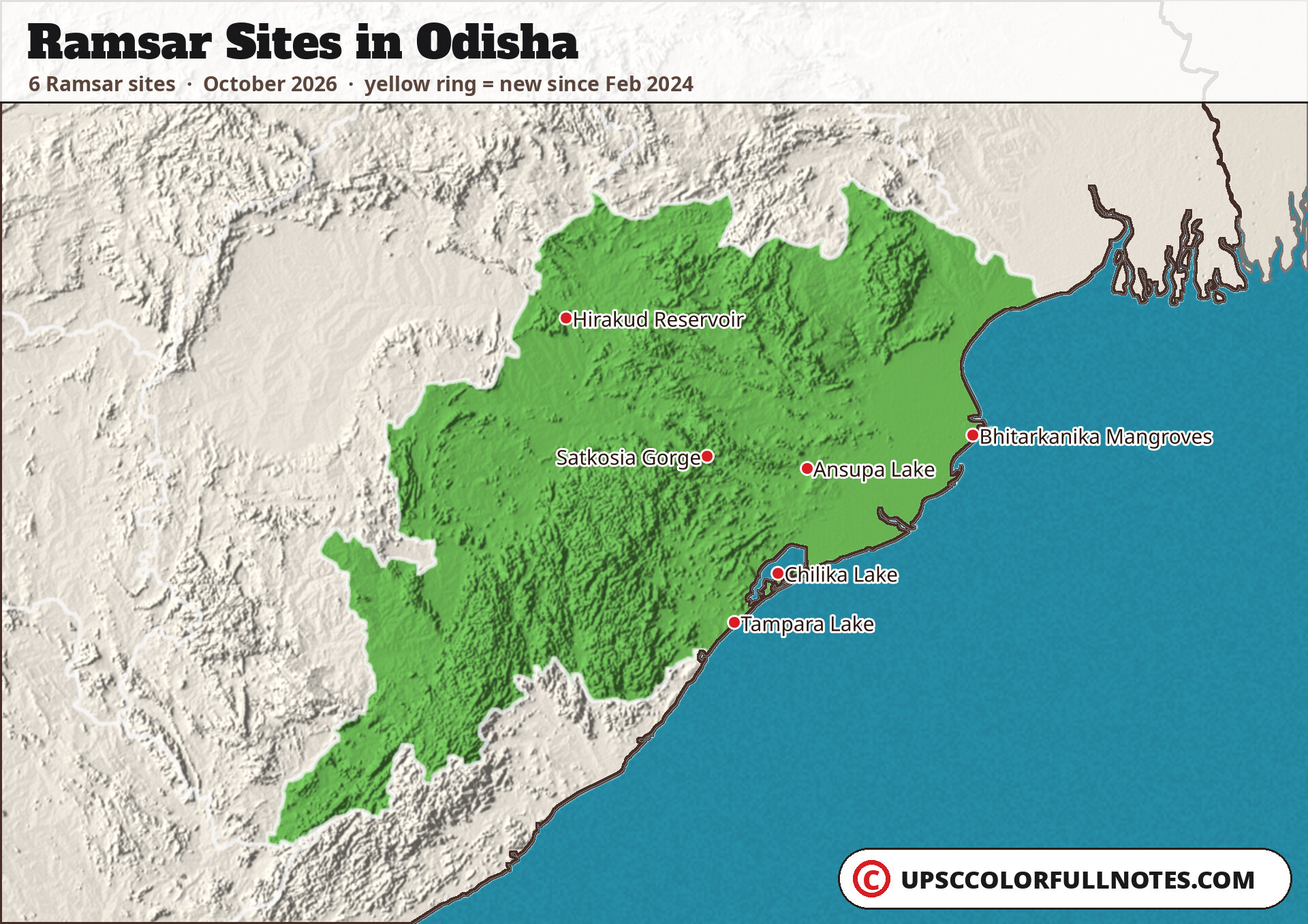
The 6 Ramsar sites of Odisha are listed below in order of designation.
| # | Ramsar site | Wetland type | Listed | Known for |
|---|---|---|---|---|
| 1 | Chilika Lake | Brackish lagoon | 1981 | India’s first Ramsar site |
| 2 | Bhitarkanika Mangroves | Mangrove forest | 2002 | Olive ridley, saltwater crocodile |
| 3 | Satkosia Gorge | Rivers, marsh, forest | 2021 | Tiger, two biogeographic regions |
| 4 | Ansupa Lake | Oxbow lake (Mahanadi) | 2021 | Indian skimmer |
| 5 | Tampara Lake | Freshwater lake | 2021 | 1766 battle crater |
| 6 | Hirakud Reservoir | Human-made reservoir | 2021 | Mahanadi dam, hydropower |
1. Chilika Lake
Chilika Lake is a brackish lake on the Odisha coast, separated from the Bay of Bengal by a long sandy ridge.
- Listed: 1 October 1981, area 116,500 ha.
- Birds: a breeding, wintering and staging area for 33 species of waterbirds.
- Montreux Record: placed on it on 16 June 1993 for siltation choking the lake mouth; removed on 11 November 2002 after rehabilitation.
- Exam point: Chilika Lake and Keoladeo National Park (Rajasthan) are India’s first two Ramsar sites, both designated 1 October 1981.
- Read more: Chilika Lake and Bhitarkanika.
2. Bhitarkanika Mangroves
Bhitarkanika Mangroves is a mangrove forest and wildlife sanctuary on the Odisha coast, one of the finest remaining mangrove patches in India.
- Listed: 19 August 2002, area 65,000 ha.
- Turtles: Gahirmatha beach hosts the largest known olive ridley sea turtle nesting beach in the world, with half a million nesting annually.
- Crocodiles: the highest density of saltwater crocodile in the country, with nearly 700 animals.
- Plants: 55 of India’s 58 recorded mangrove species, a wider mangrove diversity than the Sundarbans.
3. Satkosia Gorge
Satkosia Gorge is a mosaic of rivers, marshes and evergreen forests in Odisha, at the meeting point of the Deccan Peninsula and the Eastern Ghats.
- Listed: 12 October 2021, area 98,196.7 ha; a wildlife sanctuary since 1976.
- Wildlife: tiger, red-crowned roofed turtle, Indian narrow-headed softshell turtle and black-bellied tern.
- Plants: asan, dhaura, simal, Indian thorny bamboo and Calcutta bamboo.
- Threats: fire suppression, drought, drainage and extreme temperatures.
4. Ansupa Lake
Ansupa Lake is a small freshwater oxbow lake formed by the Mahanadi river in Odisha.
- Listed: 12 October 2021, area 231 ha.
- Wildlife: 194 bird species, 61 fish species, 244 macrophytes, 88 butterflies and 26 mammals.
- Birds: the endangered Indian skimmer and black-bellied tern, and the vulnerable river tern.
- Threats: the channel to the Mahanadi no longer works, so the lake dries in extreme droughts; sedimentation and weeds add pressure.
5. Tampara Lake
Tampara Lake is a lake in Odisha that fills a depression created by explosives during a British–French battle in 1766.
- Listed: 12 October 2021, area 300 ha.
- Water source: flood water from the Rushikulya river; the lake helps control monsoon floods.
- Wildlife: 60 bird species and 46 fish species, including the vulnerable common carp, common pochard and river tern.
- Livelihood: an estimated fish yield of 12 tonnes a year supports local communities.
- Read more: Tampara Lake in Odisha.
6. Hirakud Reservoir
Hirakud Reservoir is one of India’s largest human-made reservoirs, built across the Mahanadi river in Odisha by dams almost 26 kilometres long.
- Listed: 12 October 2021, area 65,400 ha.
- Wildlife: over 130 bird species and about 54 fish species, one endangered and six near-threatened.
- Uses: 480 tonnes of fish a year for over 7,000 fishermen, around 350 megawatts of hydropower and 436,000 ha irrigated.
- Flood control: the reservoir moderates floods in the Mahanadi Delta downstream.
Which are the Ramsar sites in Punjab?
Punjab has 6 Ramsar sites. The oldest is Harike Lake (1990), and three were listed on one day, 26 September 2019.

Download: Ramsar sites in Punjab map (HD JPG)
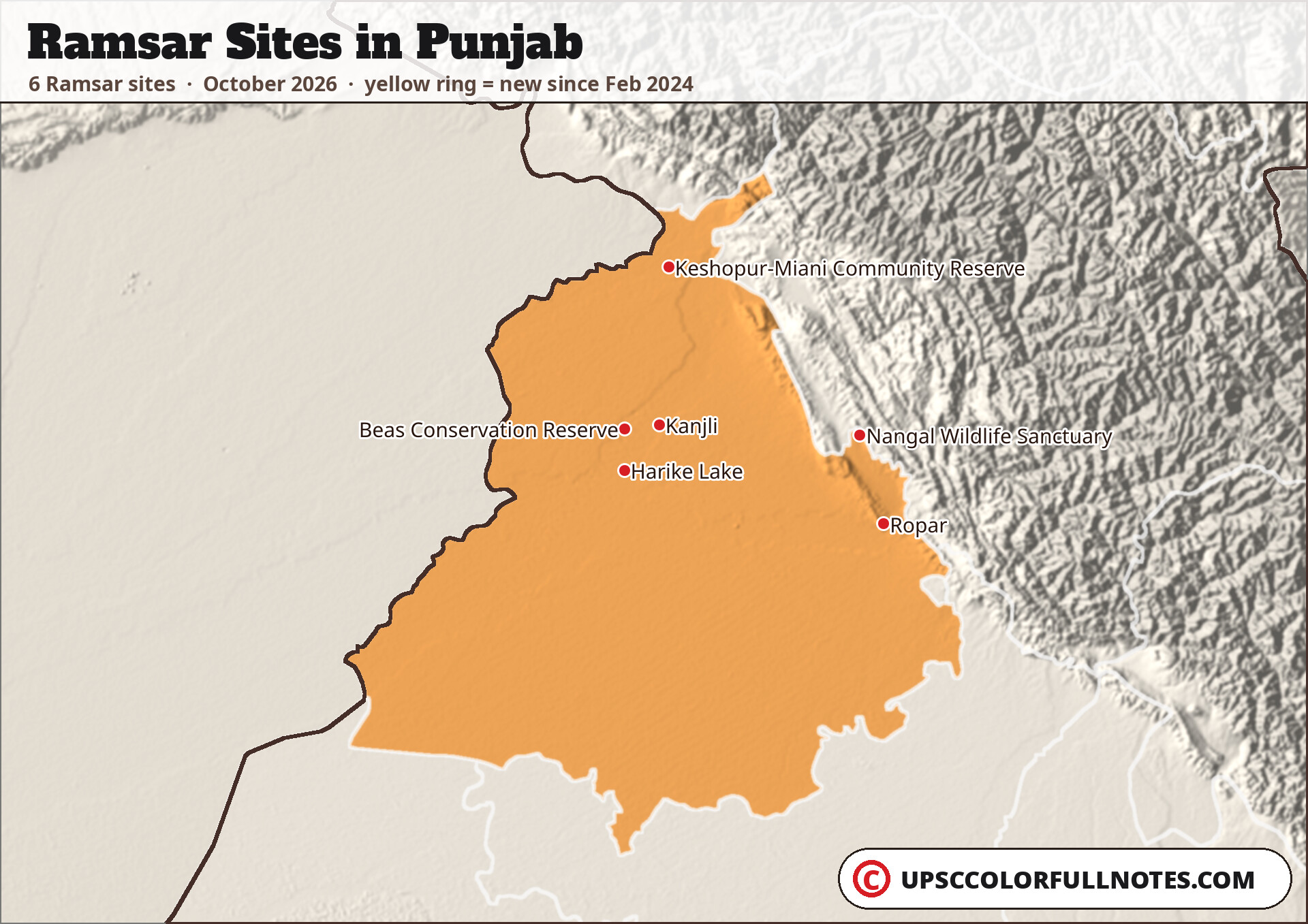
The 6 Ramsar sites of Punjab are listed below in order of designation.
| # | Ramsar site | Wetland type | Listed | Known for |
|---|---|---|---|---|
| 1 | Harike Lake | Shallow reservoir with 13 islands | 1990 | 200,000+ ducks and geese |
| 2 | Kanjli | Barrage on the Kali Bein stream | 2002 | Guru Nanak Dev Ji link |
| 3 | Ropar | Barrage lake on the Sutlej | 2002 | Smooth Indian otter, hog deer |
| 4 | Nangal Wildlife Sanctuary | Bhakra-Nangal reservoir | 2019 | Indian pangolin, Egyptian vulture |
| 5 | Beas Conservation Reserve | 185-km river stretch | 2019 | Indus river dolphin |
| 6 | Keshopur-Miani Community Reserve | Marshes and fishponds | 2019 | Community-managed wetland |
1. Harike Lake
Harike Lake is a shallow reservoir with thirteen islands at the meeting point of two rivers in Punjab.
- Listed: 23 March 1990, area 4,100 ha.
- Birds: over 200,000 ducks, geese and swans use the lake during migration for breeding, wintering and staging.
- Plants: dense floating vegetation covers 70% of the lake.
- Location: the Beas Conservation Reserve runs down to the Harike Headworks, where the Beas is split into channels.
2. Kanjli
Kanjli is a water-storage wetland on the Kali Bein stream in Punjab, formed by a small barrage built in 1870 for irrigation.
- Listed: 22 January 2002, area 183 ha.
- Water source: the Kali Bein, a permanent stream; the site regulates groundwater discharge and recharge with the seasons.
- Threats: invasive water hyacinth, rising pollution, deforestation in the catchment and excessive grazing.
- Culture: the Kali Bein is linked with Shri Guru Nanak Dev Ji, the first guru of the Sikhs.
3. Ropar
Ropar is a human-made wetland of lake and river on the Sutlej in Punjab, formed by a barrage built in 1952.
- Listed: 22 January 2002, area 1,365 ha.
- Wildlife: a breeding place for the smooth Indian otter, hog deer, sambar and several reptiles.
- Birds: about 150 local and migratory bird species, with some 35 fish species in the food chain.
- Threats: siltation from deforested hills, industrial pollutants and invasive weeds.
4. Nangal Wildlife Sanctuary
Nangal Wildlife Sanctuary is a human-made reservoir in the Shiwalik foothills of Punjab, built in 1961 under the Bhakra-Nangal Project.
- Listed: 26 September 2019, area 116 ha.
- Wildlife: the endangered Indian pangolin and Egyptian vulture, and the vulnerable leopard.
- Water source: the reservoir regulates river flow and lowers flood risk for more than half a million people downstream.
- History: the 1954 “Five Principles of Peaceful Coexistence” were formalised at Nangal by the Indian and Chinese Prime Ministers.
5. Beas Conservation Reserve
Beas Conservation Reserve is a 185-kilometre stretch of the Beas River in north-west Punjab, running from the Himalayan foothills to the Harike Headworks.
- Listed: 26 September 2019, area 6,428.9 ha.
- Wildlife: India’s only known population of the endangered Indus river dolphin, plus hog deer and the vulnerable smooth-coated otter.
- Birds: more than 500 bird species are recorded along the islands, sand bars and braided channels.
- Fish: more than 90 fish species, including the endangered masheer; 47 critically endangered gharials were released in 2017.
6. Keshopur-Miani Community Reserve
Keshopur-Miani Community Reserve is a mosaic of natural marshes, fishponds and farmed wetlands in Punjab, fed by annual rainfall run-off.
- Listed: 26 September 2019, area 343.9 ha.
- Plants: 344 plant species, with lotus and chestnut grown in the managed ponds.
- Wildlife: the vulnerable common pochard and the endangered spotted pond turtle.
- Community: a community-managed wetland that gives food to people and supports local wildlife.
Which are the Ramsar sites in Gujarat?
Gujarat has 5 Ramsar sites, the oldest being Nalsarovar (2012) and the newest Chhari Dhand (2025). Three of the five were listed in April 2021.

Download: Ramsar sites in Gujarat map (HD JPG)
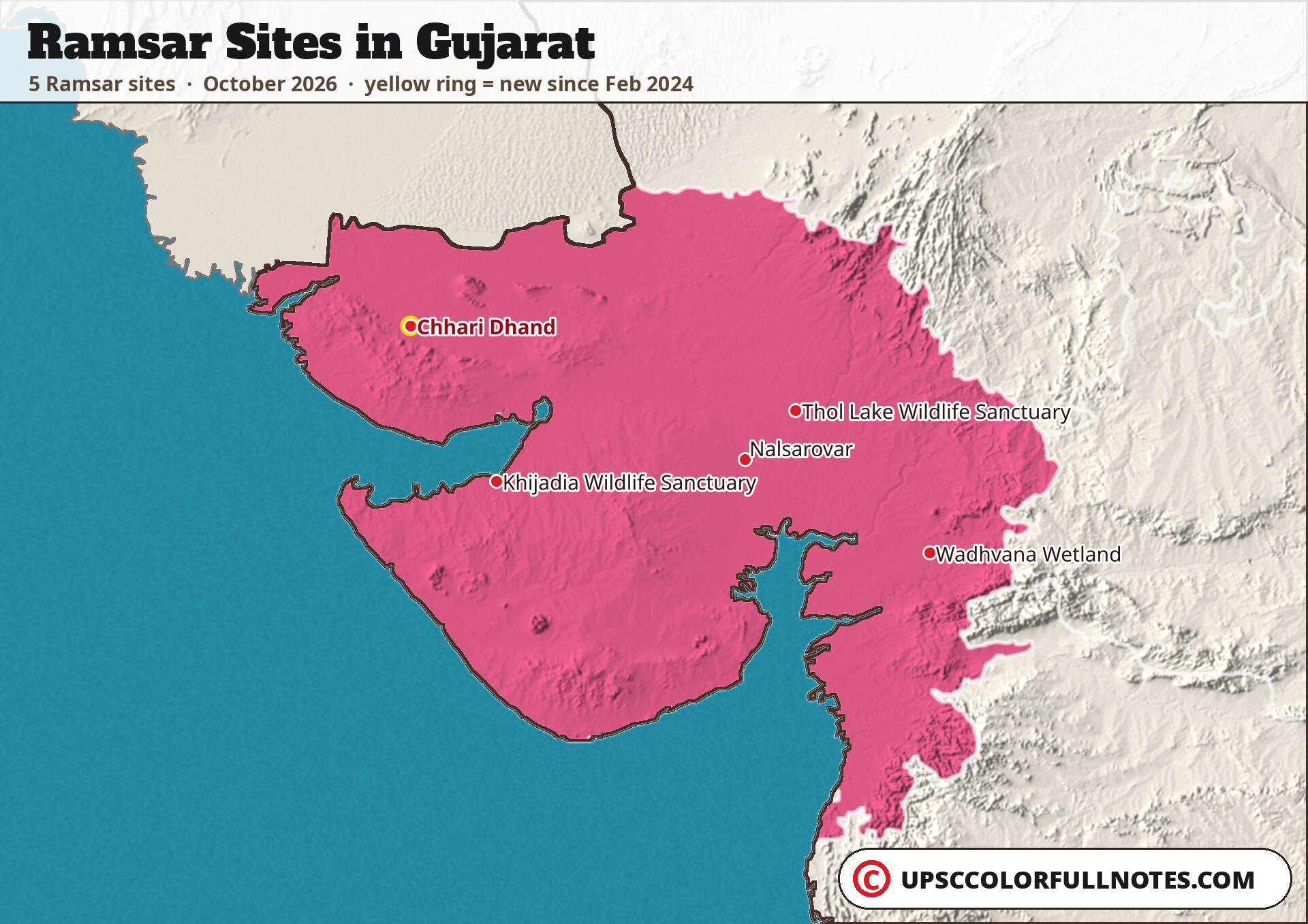
The 5 Ramsar sites of Gujarat are listed below in order of designation.
| # | Ramsar site | Wetland type | Listed | Known for |
|---|---|---|---|---|
| 1 | Nalsarovar | Natural freshwater lake (relict sea) | 2012 | 174,128 winter birds |
| 2 | Wadhvana Wetland | Irrigation reservoir (1910) | 2021 | Central Asian Flyway ducks |
| 3 | Thol Lake Wildlife Sanctuary | Shallow irrigation reservoir (1912) | 2021 | 320+ bird species |
| 4 | Khijadia Wildlife Sanctuary | Freshwater wetland behind a bund | 2021 | 20% of common cranes |
| 5 | Chhari Dhand | Seasonal saline wetland | 2025 | 30,000 common cranes |
1. Nalsarovar
Nalsarovar is a natural freshwater lake, a relict sea, and the largest natural wetland in the Thar Desert Biogeographic Province, in Gujarat.
- Listed: 24 September 2012, area 12,000 ha.
- Birds: 210 bird species; an average of 174,128 birds in winter and 50,000 in summer.
- Wildlife: the critically endangered sociable lapwing and vulnerable marbled teal stop over; the vulnerable sarus crane shelters here in summer.
- Mammals: a satellite population of the endangered Indian wild ass uses the lake in the dry season.
2. Wadhvana Wetland
Wadhvana Wetland is a reservoir built in 1910 by the former Baroda State, set in semi-arid farmland of wheat and paddy fields in Gujarat.
- Listed: 5 April 2021, area 630 ha.
- Birds: over 80 migratory species on the Central Asian Flyway; almost 46,000 birds were counted in the 2020 mid-winter census.
- Wildlife: the endangered Pallas’s fish-eagle, the vulnerable common pochard and the near-threatened Dalmatian pelican winter here.
- Rare bird: the red-crested pochard, rare elsewhere in western India, is recorded here every winter.
3. Thol Lake Wildlife Sanctuary
Thol Lake Wildlife Sanctuary is a shallow irrigation reservoir built in 1912 in Gujarat and declared a wildlife sanctuary in 1988.
- Listed: 5 April 2021, area 699 ha.
- Birds: more than 320 bird species, about 57% of Gujarat’s birds, and more than 110 waterbird species.
- Wildlife: the critically endangered white-rumped vulture and sociable lapwing, and the vulnerable sarus crane and lesser white-fronted goose.
- Glossy ibis: the lake hosts more than 1% of the glossy ibis population and supports blackbuck in the dry season.
4. Khijadia Wildlife Sanctuary
Khijadia Wildlife Sanctuary is a freshwater wetland near the coast of the Gulf of Kutch in Gujarat, formed behind a bund built in 1920.
- Listed: 13 April 2021, area 511.7 ha.
- Birds: over 310 bird species, including 125 waterbirds; over 165,000 individual waterbirds have been counted.
- Wildlife: the endangered Pallas’s fish-eagle and Indian skimmer; more than 20% of the regional common crane population is supported here.
- History: the bund was built to stop saltwater from the Gulf of Kutch entering farmland.
5. Chhari Dhand
Chhari Dhand is a seasonal saline wetland between the Banni grasslands and the salt flats of Kachchh in Gujarat, flooding in the monsoon.
- Listed: 16 June 2025, area 22,700 ha.
- Birds: approximately 30,000 common cranes every year, with the critically endangered sociable lapwing and the vulnerable common pochard.
- Plants: Indian gum tragacanth and the critically endangered Indian bdellium-tree, both adapted to dry conditions.
- Threats: invasive species; a restoration plan with local agencies, NGOs and community groups is in place.
Which are the Ramsar sites in Jammu and Kashmir?
Jammu and Kashmir has 5 Ramsar sites, the oldest being Wular Lake, listed in 1990. Two were added on 8 November 2005 and two more on 8 June 2022.

Download: Ramsar sites in Jammu and Kashmir map (HD JPG)
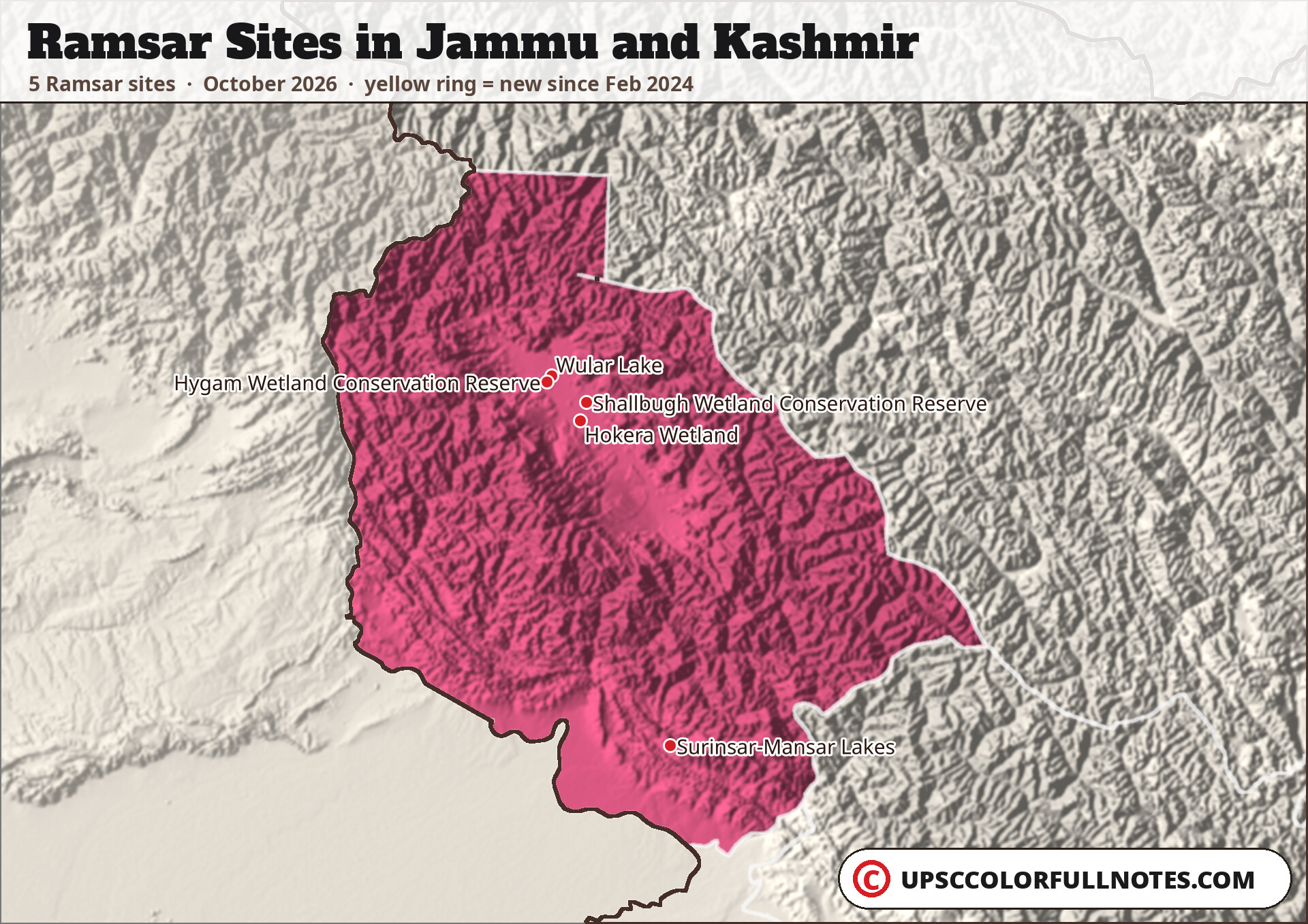
The 5 Ramsar sites of Jammu and Kashmir are listed below in order of designation.
| # | Ramsar site | Wetland type | Listed | Known for |
|---|---|---|---|---|
| 1 | Wular Lake | Freshwater lake | 1990 | Largest freshwater lake in India |
| 2 | Hokera Wetland | Natural perennial marsh | 2005 | Last reedbeds of Kashmir |
| 3 | Surinsar-Mansar Lakes | Composite freshwater lake | 2005 | Sacred lakes, temples |
| 4 | Shallbugh Wetland Conservation Reserve | Shallow reed-bed wetland | 2022 | Steppe eagle, Pallas’s fish-eagle |
| 5 | Hygam Wetland Conservation Reserve | Floodplain wetland below Wular | 2022 | 40,000+ birds a year |
1. Wular Lake
Wular Lake is the largest freshwater lake in India, with wide marshes of floating and emergent plants, in Jammu and Kashmir.
- Listed: 23 March 1990, area 18,900 ha.
- Plants: water chestnut from the marshes earns revenue for the state and feeds livestock.
- Birds: an important area for wintering, staging and breeding birds.
- Exam point: UPSC Prelims 2023 asked about Wular Lake; the Jhelum river passes through it.
2. Hokera Wetland
Hokera Wetland is a natural perennial marsh next to the Jhelum basin, only 10 km from Srinagar in Jammu and Kashmir.
- Listed: 8 November 2005, area 1,375 ha.
- Birds: 68 waterfowl species pass through, including the endangered white-eyed pochard, arriving from Siberia, China, Central Asia and northern Europe.
- Plants: the only site with remaining reedbeds in Kashmir, behind the Pir Panjal range.
- Exam point: UPSC Prelims 2022 paired Hokera with Punjab as a trap; Hokera is in Jammu and Kashmir.
3. Surinsar-Mansar Lakes
Surinsar-Mansar Lakes is a composite freshwater lake in the semi-arid Panjab plains of Jammu and Kashmir, ringed by temples.
- Listed: 8 November 2005, area 350 ha.
- Water source: Surinsar is rain-fed with no permanent outflow; Mansar is fed by surface run-off and water passing through paddy fields.
- Birds: water high in micronutrients makes the lakes a breeding and nursery ground for migratory waterfowl.
- Threats: rising visitor numbers, farm run-off, bathing and cremation rituals; fishing is discouraged for religious reasons.
4. Shallbugh Wetland Conservation Reserve
Shallbugh Wetland Conservation Reserve is a shallow wetland west of Anchar Lake in the Sindh river delta of Jammu and Kashmir.
- Listed: 8 June 2022, area 1,675 ha.
- Water source: rainfall, snowmelt from the Kashmir Himalayas and streams from the Sindh river and Anchar Lake.
- Birds: over 21 resident and migratory species, including the endangered steppe eagle, Pallas’s fish-eagle and black-bellied tern.
- Nearby site: Shallbugh lies close to Hokera Wetland, another Ramsar site; excessive siltation is its biggest threat.
5. Hygam Wetland Conservation Reserve
Hygam Wetland Conservation Reserve is a wetland in the Jhelum river basin of Jammu and Kashmir, lying downstream of and connected to Wular Lake.
- Listed: 8 June 2022, area 801.8 ha.
- Birds: over 40,000 migratory and resident birds are recorded every year on the Central Asian Flyway.
- Wildlife: Eurasian otter, common carp and common pochard.
- Threats: continuous siltation, willow plantations and nutrient build-up; an integrated management plan has run since 2002.
Which are the Ramsar sites in Madhya Pradesh?
Madhya Pradesh has 5 Ramsar sites, from Bhoj Wetland in 2002 to Tawa Reservoir in 2024. All five are human-made reservoirs or lakes.

Download: Ramsar sites in Madhya Pradesh map (HD JPG)
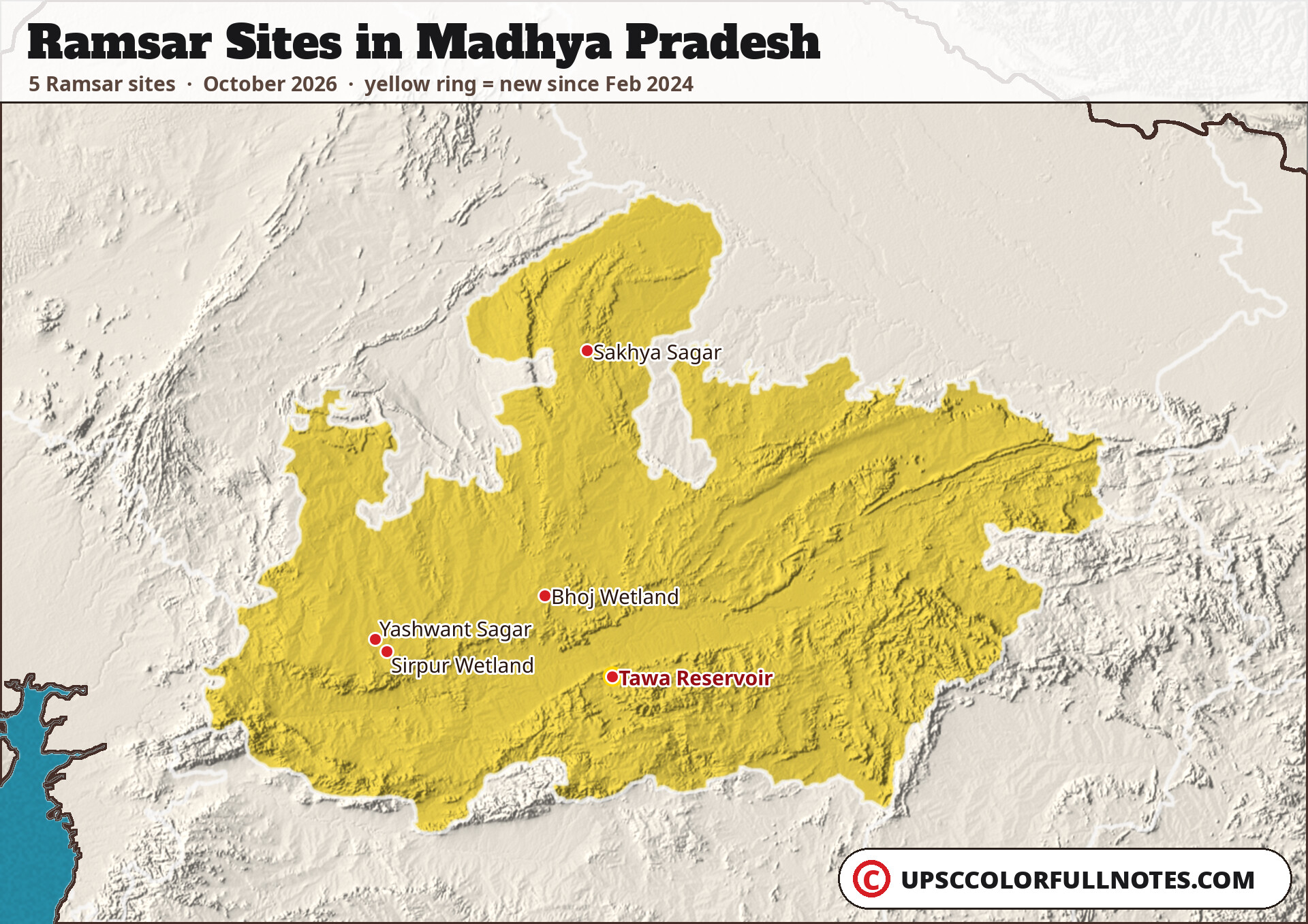
The 5 Ramsar sites of Madhya Pradesh are listed below in order of designation.
| # | Ramsar site | Wetland type | Listed | Known for |
|---|---|---|---|---|
| 1 | Bhoj Wetland | Two human-made reservoirs | 2002 | Upper Lake, Bhopal |
| 2 | Sirpur Wetland | Shallow alkaline lake | 2022 | 130 bird species |
| 3 | Sakhya Sagar | Reservoir in Madhav National Park | 2022 | Mugger crocodile, Prelims 2026 |
| 4 | Yashwant Sagar | Irrigation reservoir (1930s) | 2022 | 239 bird species, IBA |
| 5 | Tawa Reservoir | Dam reservoir in Satpura Tiger Reserve | 2024 | Tor mahseer, state fish |
1. Bhoj Wetland
Bhoj Wetland is a pair of adjoining human-made reservoirs at Bhopal in Madhya Pradesh, the Upper Lake and the Lower Lake.
- Listed: 19 August 2002, area 3,201 ha.
- Water source: the Upper Lake was formed in the 11th century by an earthen dam across the Kolans River.
- History: the Lower Lake, about 200 years old, formed largely from leakage of the Upper Lake and is surrounded by Bhopal city.
- Wildlife: rich in water plants, plankton, natural and cultured fish, resident and migratory birds, reptiles and amphibians.
2. Sirpur Wetland
Sirpur Wetland is a shallow, alkaline, nutrient-rich human-made lake in Madhya Pradesh, known locally as Pakshi Vihar (bird sanctuary).
- Listed: 7 January 2022, area 161 ha.
- Birds: 130 bird species, including common pochard, Egyptian vulture and Indian river tern, gather in winter.
- Plants: some 175 land plant species, six water plants and 30 natural and cultured fish species.
- Water source: monsoon rain floods the lake to a maximum depth of two metres.
3. Sakhya Sagar
Sakhya Sagar is a human-made reservoir on the outskirts of Shivpuri town, inside Madhav National Park in Madhya Pradesh.
- Listed: 7 January 2022, area 248 ha.
- Wildlife: mugger crocodile, 19 fish species, nine reptiles and 19 mammals; 73 bird species use it as a staging ground.
- Lake type: one of the “three lakes of Shivpuri”, a shallow, alkaline, nutrient-rich reservoir.
- Exam point: UPSC Prelims 2026 asked about Sakhya Sagar together with Madhav National Park (Shivpuri).
4. Yashwant Sagar
Yashwant Sagar is a freshwater reservoir in the Gambhir river basin of Madhya Pradesh, built in the 1930s to supply Indore with water.
- Listed: 7 January 2022, area 822.9 ha.
- Birds: around 239 bird species, including the vulnerable sarus crane, nest and feed when water recedes in winter.
- Fish: 39 fish species; the reservoir is used for commercial aquaculture.
- IBA status: an Important Bird and Biodiversity Area (IBA) and one of the region’s main birdwatching sites.
5. Tawa Reservoir
Tawa Reservoir is a man-made wetland behind Tawa Dam inside Satpura Tiger Reserve, in the Central Indian Highlands of Madhya Pradesh.
- Listed: 8 January 2024, area 20,050 ha.
- Fish: 57 fish species; a spawning ground for the vulnerable common carp, shark catfish and the tor mahseer, the state fish.
- Wildlife: 21 mammals and over 280 migratory birds; the Indian giant squirrel, endemic to India, lives around the reservoir.
- Water source: the Tawa Dam, built mainly for irrigation.
Which are the Ramsar sites in Rajasthan?
Rajasthan has 5 Ramsar sites, including Keoladeo National Park, one of India’s first two. Three of the five were added in 2025.

Download: Ramsar sites in Rajasthan map (HD JPG)
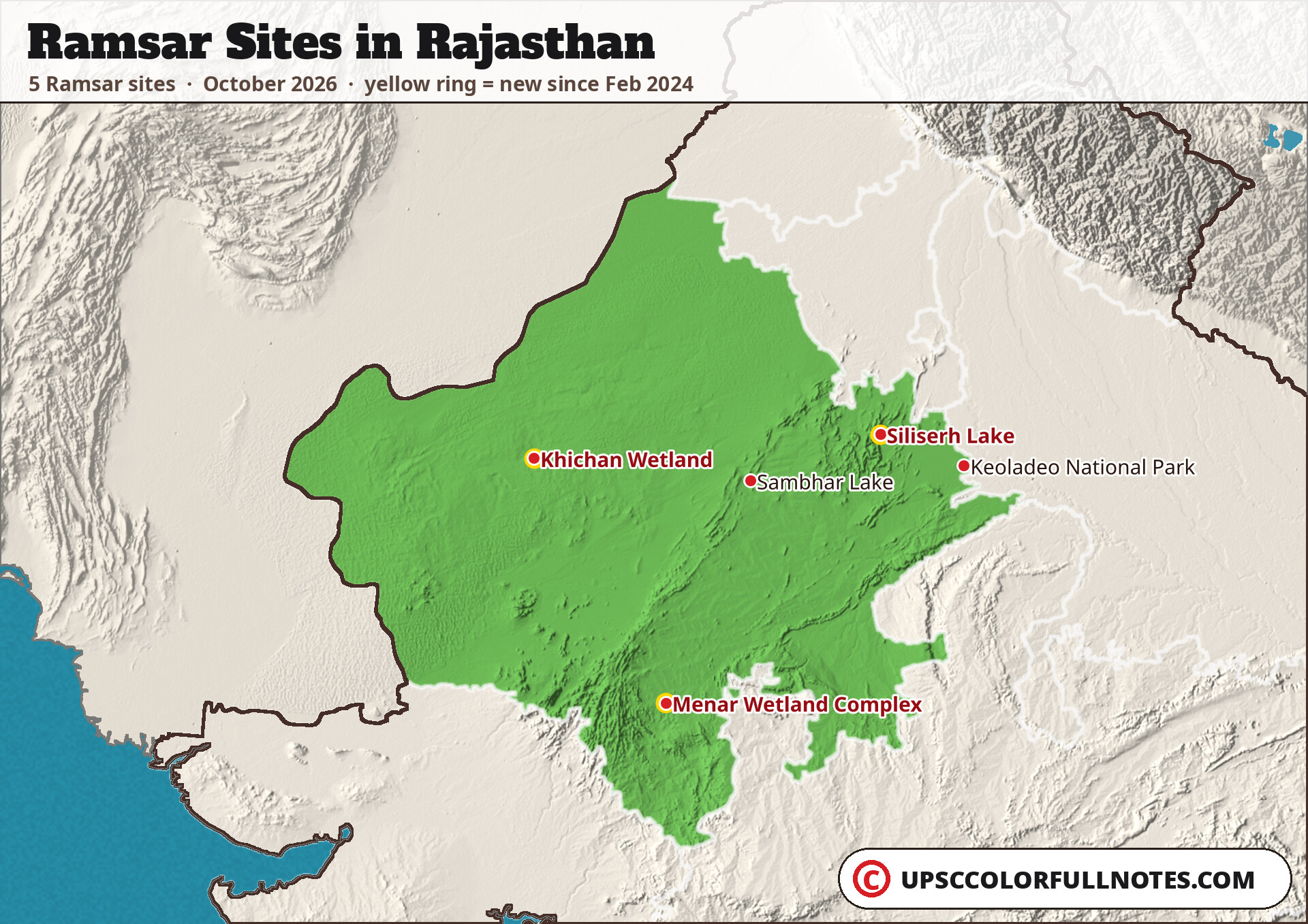
The 5 Ramsar sites of Rajasthan are listed below in order of designation.
| # | Ramsar site | Wetland type | Listed | Known for |
|---|---|---|---|---|
| 1 | Keoladeo National Park | Ten artificial seasonal lagoons | 1981 | India’s first, Montreux Record |
| 2 | Sambhar Lake | Large saline lake | 1990 | Flamingos, salt production |
| 3 | Menar Wetland Complex | Three monsoon ponds | 2025 | Community-led conservation |
| 4 | Khichan Wetland | Desert river and pond | 2025 | 22,000 demoiselle cranes |
| 5 | Siliserh Lake | Human-made lake, Sariska buffer | 2025 | Black stork, tiger |
1. Keoladeo National Park
Keoladeo National Park is a complex of ten artificial seasonal lagoons in a densely populated part of Rajasthan, and a World Heritage Site.
- Listed: 1 October 1981, area 2,873 ha.
- Birds: breeding, wintering and staging migratory birds; an invasive grass has reduced the habitat of the Siberian crane.
- Threats: placed on the Montreux Record on 4 July 1990 for “water shortage and an unbalanced grazing regime”.
- Exam point: with Chilika Lake, one of India’s first two Ramsar sites, both designated 1 October 1981.
2. Sambhar Lake
Sambhar Lake is a large saline lake in Rajasthan, fed by four streams and ringed by sand flats and dry thorn scrub.
- Listed: 23 March 1990, area 24,000 ha.
- Birds: wintering waterbirds, including large numbers of flamingos.
- Water source: seasonal rivers and streams; water levels change with the seasons.
- Uses: salt production and livestock grazing are the main human uses.
3. Menar Wetland Complex
Menar Wetland Complex is a freshwater monsoon wetland of three ponds and connecting farmland in Rajasthan, next to Menar village.
- Listed: 19 February 2025, area 463.4 ha.
- Birds: 110 waterbird species, 67 of them migratory, plus the critically endangered white-rumped and long-billed vultures.
- Plants: over 70 plant species; mango trees around Braham talab hold a large colony of Indian flying fox.
- Community: villagers of Menar prevent poaching and fishing, one of Rajasthan’s best examples of community-led conservation.
4. Khichan Wetland
Khichan Wetland is a desert wetland in the northern Thar of Rajasthan, made up of the Ratri river, Vijaysagar pond and scrub land.
- Listed: 19 February 2025, area 54.2 ha.
- Birds: over 150 bird species; over 22,000 migratory demoiselle cranes winter here every year.
- Threats: power-line collisions and stray dog attacks on the cranes, which the villagers work to reduce.
- Plants: drought-resistant plants of the Thar Desert give the cranes their habitat.
5. Siliserh Lake
Siliserh Lake is a human-made lake from the mid-nineteenth century in the buffer zone of Sariska Tiger Reserve, Rajasthan.
- Listed: 7 July 2025, area 316.0 ha.
- Birds: 149 bird species, including the vulnerable river tern and more than 1% of the black stork population.
- Wildlife: 17 mammal species, including the endangered tiger.
- Threats: intensive agriculture and expanding settlements; a restoration plan is under way.
Which are the Ramsar sites in Karnataka?
Karnataka has 4 Ramsar sites. Three of the four were listed in early 2023, and two of them are human-made irrigation tanks.

Download: Ramsar sites in Karnataka map (HD JPG)
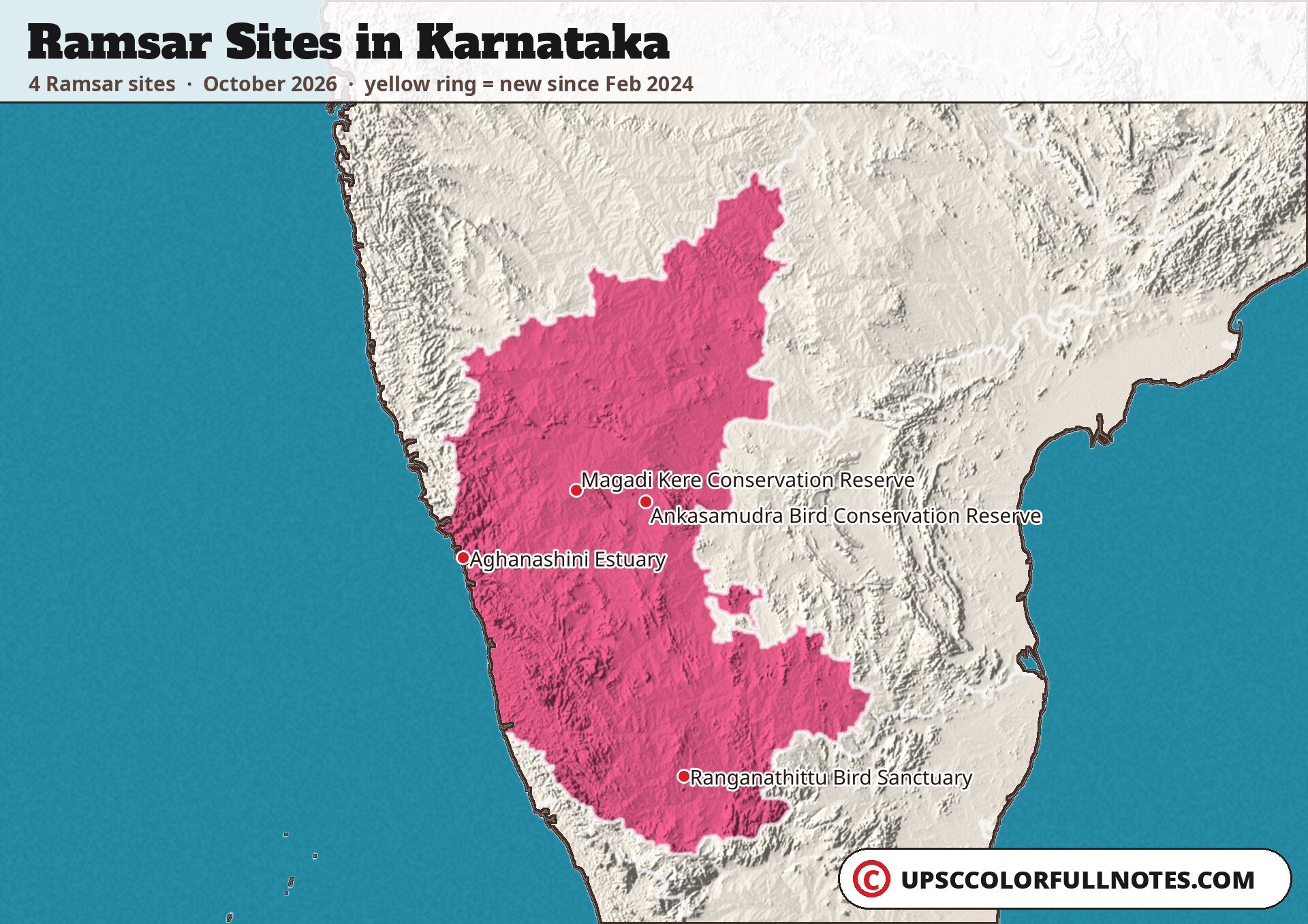
The 4 Ramsar sites of Karnataka are listed below in order of designation.
| # | Ramsar site | Wetland type | Listed | Known for |
|---|---|---|---|---|
| 1 | Ranganathittu Bird Sanctuary | Riverine wetland on the Kaveri | 2022 | Painted stork, mugger crocodile |
| 2 | Aghanashini Estuary | Estuary on the Arabian Sea | 2023 | 55,000 birds, kagga rice |
| 3 | Magadi Kere Conservation Reserve | Human-made alkaline tank | 2023 | Bar-headed goose wintering |
| 4 | Ankasamudra Bird Conservation Reserve | Human-made tank | 2023 | 35,000 birds, endemic fish |
1. Ranganathittu Bird Sanctuary
Ranganathittu Bird Sanctuary is a riverine wetland on the Kaveri River in the southern Deccan plateau of Karnataka.
- Listed: 15 February 2022, area 517.7 ha.
- Birds: over 1% of the global population of painted stork, spot-billed pelican and black-headed ibis, making it an Important Bird and Biodiversity Area.
- Wildlife: healthy populations of mugger crocodile, smooth-coated otter and hump-backed mahseer.
- River: the Kaveri rises in the Western Ghats and flows east to the Bay of Bengal, passing through this sanctuary.
2. Aghanashini Estuary
Aghanashini Estuary is the estuary where the Aghanashini River meets the Arabian Sea on the Karnataka coast, with mudflats, rocky shores and rice fields.
- Listed: 14 February 2023, area 4,801 ha.
- Birds: about 55,000 birds; more than 1% of the regional population of nine species, and almost 10% of the regional black-headed ibis.
- Wildlife: more than 80 fish, 115 birds and 45 mangrove and mangrove-associated species, including the threatened halavi guitarfish and lesser adjutant.
- People: more than 6,000 households fish, farm, mine bivalve shells, make salt and grow the salt-tolerant “kagga” rice.
3. Magadi Kere Conservation Reserve
Magadi Kere Conservation Reserve is a human-made tank in northern Karnataka, built to store monsoon rain for irrigation.
- Listed: 14 February 2023, area 54.4 ha.
- Birds: more than 165 bird species; some 30,000 waterbirds including 8,000 wintering birds, with one of southern India’s largest bar-headed goose wintering grounds.
- Wildlife: the globally endangered Indian pangolin has been seen near the tank.
- Water source: monsoon rain; the water turned so alkaline over time that it is no longer fit for irrigation.
4. Ankasamudra Bird Conservation Reserve
Ankasamudra Bird Conservation Reserve is a human-made tank in Karnataka, built to store monsoon run-off from the Tungabhadra River for irrigation.
- Listed: 10 March 2023, area 98.8 ha.
- Birds: some 35,000 birds of 240 species; about 30 waterbird species breed here, and at least 20% of the regional glossy ibis population visits.
- Fish: nine endemic fish species, three of them globally endangered: tiger loach, aruli barb and nukta.
- Threats: invasive alligator weed, Prosopis shrub and African catfish are harming native fish and waterbirds.
Which are the Ramsar sites in Himachal Pradesh?
Himachal Pradesh has 3 Ramsar sites, with Pong Dam Lake the largest at 15,662 ha. Two of the three were listed on 8 November 2005.

Download: Ramsar sites in Himachal Pradesh map (HD JPG)
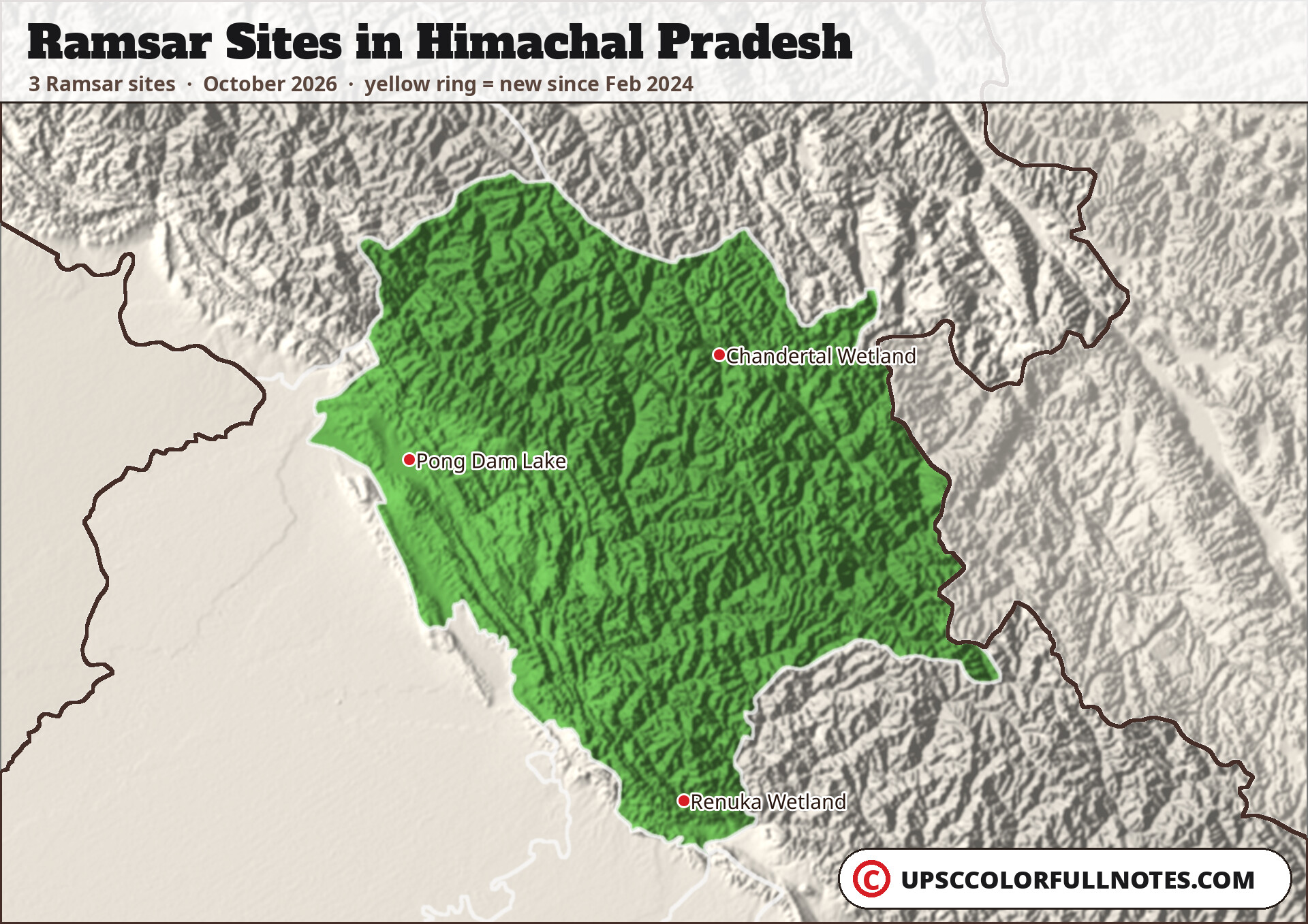
The 3 Ramsar sites of Himachal Pradesh are listed below in order of designation.
| # | Ramsar site | Wetland type | Listed | Known for |
|---|---|---|---|---|
| 1 | Pong Dam Lake | Reservoir on the Beas (1975) | 2002 | 220+ bird species |
| 2 | Chandertal Wetland | High-altitude lake, 4,337 m | 2005 | Snow leopard, Kunzam pass |
| 3 | Renuka Wetland | Spring-fed karst lake | 2005 | Prelims 2022, 20 ha |
1. Pong Dam Lake
Pong Dam Lake is a water-storage reservoir created in 1975 on the Beas River in the low Himalayan foothills of Himachal Pradesh.
- Listed: 19 August 2002, area 15,662 ha.
- Birds: more than 220 bird species, with 54 waterfowl species, on the trans-Himalayan flyway.
- Fish: 27 fish species; some 1,800 fishermen now work the reservoir directly.
- Uses: the dam sends electricity to neighbouring states and irrigation water to Punjab and Rajasthan.
2. Chandertal Wetland
Chandertal Wetland is a high-altitude lake at 4,337 m in the upper Chandra valley of Himachal Pradesh, near the Kunzam pass.
- Listed: 8 November 2005, area 49 ha.
- Wildlife: the Red-listed snow leopard, Himalayan ibex, blue sheep and red fox.
- Birds: snow cock, chukor, golden eagle, kestrel and chough.
- Threats: overgrazing by nomadic herders has degraded 65% of the catchment; summer trekking and litter add pressure.
3. Renuka Wetland
Renuka Wetland is a natural spring-fed lake with underground karst formations in the lower Himalaya of Himachal Pradesh, draining to the Giri river.
- Listed: 8 November 2005, area 20 ha.
- Birds: 103 bird species, 66 of them resident, including barbets, egrets, herons and mallards.
- Culture: the lake is named after the mother of the Hindu sage Parshuram and draws thousands of pilgrims.
- Exam point: UPSC Prelims 2022 listed “Renuka Wetland : Himachal Pradesh” as a correct pair; at 20 ha, only Vembannur is smaller.
Which are the Ramsar sites in Kerala?
Kerala has 3 Ramsar sites. All three were listed on the same day, 19 August 2002, and two of them are estuaries on the Arabian Sea coast.

Download: Ramsar sites in Kerala map (HD JPG)
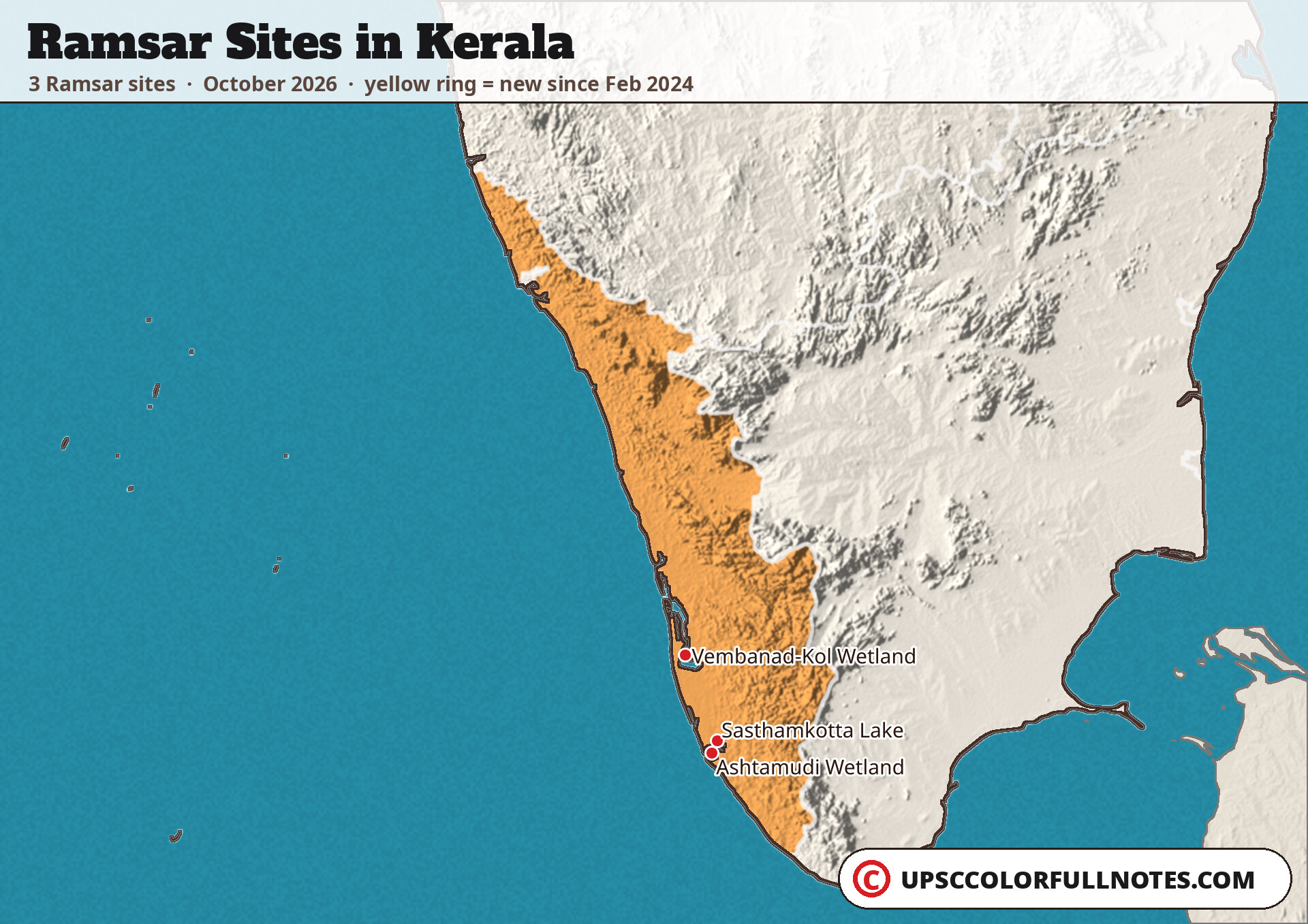
The 3 Ramsar sites of Kerala are listed below in order of designation.
| # | Ramsar site | Wetland type | Listed | Known for |
|---|---|---|---|---|
| 1 | Ashtamudi Wetland | Estuary | 2002 | Nearly 100 fish species |
| 2 | Sasthamkotta Lake | Spring-fed freshwater lake | 2002 | Drinking water, pure water |
| 3 | Vembanad-Kol Wetland | Brackish estuarine wetland | 2002 | India’s second-largest Ramsar site |
1. Ashtamudi Wetland
Ashtamudi Wetland is an estuary on the coast of Kerala, the second largest estuarine system in the state.
- Listed: 19 August 2002, area 6,140 ha.
- Fish: nearly 100 fish species support a fishing industry on which thousands of fishermen depend.
- Birds: 57 bird species, six of them migratory, with mangroves and over 40 associated plant species.
- Threats: oil spills from thousands of fishing boats, industrial pollution and conversion of habitat for development.
2. Sasthamkotta Lake
Sasthamkotta Lake is the largest freshwater lake in Kerala, spring-fed and the drinking water source for half a million people.
- Listed: 19 August 2002, area 373 ha.
- Fish: some 27 freshwater fish species.
- Water source: springs; the water holds no common salts or minerals, and a larva called “cavaborus” removes bacteria, keeping it exceptionally pure.
- Exam point: UPSC Prelims 2022 paired it with Tamil Nadu as a trap; Sasthamkotta is in Kerala.
3. Vembanad-Kol Wetland
Vembanad-Kol Wetland is the largest brackish, humid tropical wetland on the south-west coast of India, in Kerala, fed by 10 rivers.
- Listed: 19 August 2002, area 151,250 ha.
- Birds: the third largest waterfowl population in India in winter; over 90 resident and 50 migratory bird species in the Kol area.
- People: the wetland gives flood protection to three thickly populated coastal districts, recharges wells and carries local transport and trade.
- Exam point: India’s second-largest Ramsar site after Sundarban Wetland (4,23,000 ha); Chilika Lake comes next.
Which are the Ramsar sites in Maharashtra?
Maharashtra has 3 Ramsar sites, all listed since 2019. Two of the three lie on the Deccan Plateau; the third, Thane Creek, is a brackish creek with mangrove forests.

Download: Ramsar sites in Maharashtra map (HD JPG)
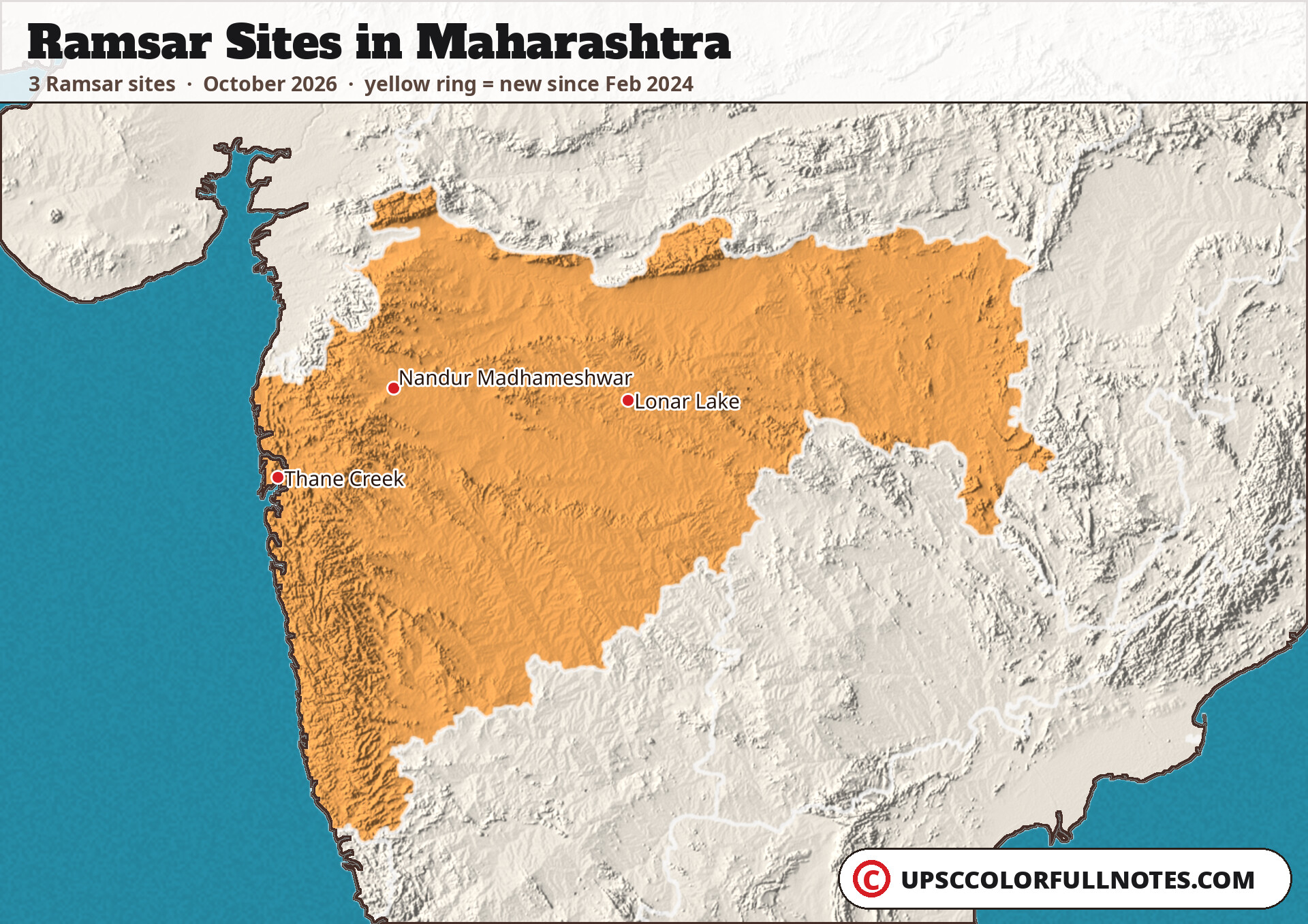
The 3 Ramsar sites of Maharashtra are listed below in order of designation.
| # | Ramsar site | Wetland type | Listed | Known for |
|---|---|---|---|---|
| 1 | Nandur Madhameshwar | Lakes and marshes behind a weir | 2019 | 536 species, Godavari |
| 2 | Lonar Lake | Meteorite crater lake | 2020 | Saline, alkaline, closed basin |
| 3 | Thane Creek | Brackish creek with mangroves | 2022 | Flamingos |
1. Nandur Madhameshwar
Nandur Madhameshwar is a mosaic of lakes, marshes and riverside forest on the Deccan Plateau of Maharashtra, formed behind a weir.
- Listed: 21 June 2019, area 1,437 ha.
- Location: the weir stands at the confluence of the Godavari and Kadwa rivers, in the rain shadow of the Western Ghats.
- Wildlife: 536 species recorded, including leopard, Indian sandalwood and the critically endangered Deolali minnow, Indian vulture and white-rumped vulture.
- Threats: water hyacinth, urban development and water abstraction.
2. Lonar Lake
Lonar Lake is a closed, almost circular crater lake on the Deccan Plateau of Maharashtra, formed by a meteorite impact on basalt.
- Listed: 22 July 2020, area 427 ha.
- Water source: springs feed the lake; with no outflow, evaporation makes the water highly saline and alkaline.
- Wildlife: 160 bird species, including the vulnerable Asian woollyneck and common pochard, 46 reptile species and 12 mammals including the grey wolf.
- Threats: household sewage, urban wastewater and unsustainable tourism.
3. Thane Creek
Thane Creek is one of the largest creeks in Asia, a brackish mangrove wetland in Maharashtra fed by many freshwater sources.
- Listed: 13 April 2022, area 6,521.1 ha.
- Birds: a sanctuary for flamingos and other Central Asian Flyway migrants; listed as an Important Bird and Biodiversity Area.
- Wildlife: the endangered great knot and the vulnerable river tern, Mozambique tilapia and Sulawesi fruit bat.
- Coastal protection: mangroves shield the area from floods, cyclones and seawater intrusion and serve as fish nurseries.
Which are the Ramsar sites in Haryana?
Haryana has 2 Ramsar sites, both listed on 25 May 2021. Both support large shares of the greylag goose population.
1. Sultanpur National Park
Sultanpur National Park is a shallow lake with artificial islands in Haryana, fed by canal overflow and saline groundwater.
- Listed: 25 May 2021, area 142.5 ha.
- Birds: more than 220 waterbird species, with over 7% of the bar-headed goose and over 8% of the greylag goose regional populations.
- Wildlife: the critically endangered sociable lapwing and the endangered Egyptian vulture, saker falcon, Pallas’s fish eagle and black-bellied tern.
- Eco-sensitive zone: land within five kilometres of the park has been an eco-sensitive zone since 2010.
2. Bhindawas Wildlife Sanctuary
Bhindawas Wildlife Sanctuary is a human-made freshwater wetland and the largest wetland in Haryana, protected since 1986.
- Listed: 25 May 2021, area 412 ha.
- Birds: over 250 species rest and roost here; more than 1.7% of greylag geese and more than 2% of Indian cormorants.
- Wildlife: nilgai, common mongoose and black-naped hare; threatened birds include the steppe eagle and Egyptian vulture.
- Water source: the wetland recharges groundwater and acts as a natural flood buffer.
Which are the Ramsar sites in Ladakh?
Ladakh has 2 Ramsar sites, Tsomoriri (2002) and Tso Kar Wetland Complex (2020). Both are high-altitude lakes above 4,500 m.
1. Tsomoriri
Tsomoriri is a freshwater-to-brackish lake at 4,595 m in the Changthang of Ladakh, with wet meadows and borax wetlands along its shores.
- Listed: 19 August 2002, area 12,000 ha.
- Birds: the only breeding ground outside China for the endangered black-necked crane, and the only breeding ground for bar-headed geese in India.
- Wildlife: the Tibetan wild ass and the great Tibetan sheep (argali), both endemic to the Tibetan plateau.
- Agriculture: the barley fields at Korzok are described as the highest cultivated land in the world.
- Drainage: Tsomoriri has no outflow.
2. Tso Kar Wetland Complex
Tso Kar Wetland Complex is a pair of connected high-altitude lakes above 4,500 m in the Changthang region of Ladakh.
- Listed: 17 November 2020, area 9,577 ha.
- Water source: glacial meltwater feeds the freshwater Startsapuk Tso and the larger hypersaline Tso Kar, named for its white salt crust.
- Wildlife: the endangered saker falcon and dhole, and the vulnerable snow leopard.
- Birds: one of India’s most important breeding areas for the black-necked crane and a stopover on the Central Asian Flyway.
Which are the Ramsar sites in West Bengal?
West Bengal has 2 Ramsar sites. One is a city waste-water wetland beside Kolkata, the other is India’s largest Ramsar site in the Sundarbans delta.
1. East Calcutta Wetlands
East Calcutta Wetlands is a multiple-use wetland serving the city of Kolkata, treating its waste water for fish ponds and farming.
- Listed: 19 August 2002, area 12,500 ha.
- Uses: fish ponds covering about 4,000 ha act as solar reactors that clean the waste water.
- Livelihood: about 150 tons of fresh vegetables a day and some 10,500 tons of fish a year, for about 50,000 people directly.
- Threats: industries adding metals to the waste-water channels, which threatens the edible quality of the fish and vegetables.
2. Sundarban Wetland
Sundarban Wetland is India’s part of the world’s largest mangrove forest, in the delta of the Ganga and Brahmaputra on the Bay of Bengal.
- Listed: 30 January 2019, area 4,23,000 ha.
- Plants: over 60 % of India’s mangrove forest area and 90 % of Indian mangrove species.
- Wildlife: the only mangrove habitat with a significant tiger population, plus the endangered Irrawaddy dolphin and the vulnerable fishing cat.
- Exam point: Sundarban Wetland is India’s largest Ramsar site (4,23,000 ha); Vembanad-Kol Wetland and Chilika Lake come next.
Which is the Ramsar site in Andhra Pradesh?
Andhra Pradesh has 1 Ramsar site, Kolleru Lake, listed in 2002. The lake sits between the deltas of the Godavari and the Krishna.
1. Kolleru Lake
Kolleru Lake is a natural eutrophic lake in coastal Andhra Pradesh, lying between the Godavari and Krishna river basins.
- Listed: 19 August 2002, area 90,100 ha.
- Birds: resident and migratory birds, including declining numbers of the vulnerable grey pelican.
- Water source: two seasonal rivers and a number of drains and channels; the lake works as a natural flood-balancing reservoir between the two deltas.
- Exam point: UPSC Prelims 2023 asked about it; Kolleru lies between the Krishna and Godavari deltas and is not fed directly by the Krishna.
Which is the Ramsar site in Arunachal Pradesh?
Arunachal Pradesh has 1 Ramsar site, Glaw Lake, listed in January 2026 as India’s 101st Ramsar site.
1. Glaw Lake
Glaw Lake is a freshwater lake inside Kamlang Tiger Reserve and Wildlife Sanctuary in the Eastern Himalayas of Arunachal Pradesh.
- Listed: 21 January 2026, India’s 101st Ramsar site, area 129.0 ha.
- Wildlife: four big cats in the wider reserve (tiger, leopard, clouded leopard, snow leopard) and the critically endangered white-bellied heron.
- Plants: more than 150 tree species and 49 orchid species in the site and its catchment.
- Culture: the local Mishmi community regards the lake as sacred.
Which is the Ramsar site in Assam?
Assam has 1 Ramsar site, Deepor Beel, a lake in a former channel of the Brahmaputra beside Guwahati.
1. Deepor Beel
Deepor Beel is a permanent freshwater lake in a former channel of the Brahmaputra in Assam, and Guwahati’s only major storm-water storage basin.
- Listed: 19 August 2002, area 4,000 ha.
- Birds: a staging site on migratory flyways; winter brings some of Assam’s largest waterbird gatherings, including spot-billed pelican and Baer’s pochard.
- Fish: 50 species support surrounding villages; water-lily nuts, giant water lily seeds and ornamental fish earn money in local markets.
- Threats: over-fishing, hunting of waterbirds, pesticide and fertilizer pollution, water hyacinth and a proposed city sewage canal.
Which is the Ramsar site in Chandigarh?
Chandigarh has 1 Ramsar site, Sukhna Wetland, listed in 2026. The reservoir lies on the edge of the city at the base of the Outer Himalayas.
1. Sukhna Wetland
Sukhna Wetland is a peri-urban reservoir on the edge of Chandigarh at the base of the Outer Himalayas, and India’s 102nd Ramsar site.
- Listed: 16 March 2026, Ramsar site no. 2602, announced on 15 October 2026, area 199.5 ha.
- Birds: resident waterbirds and Central Asian Flyway migrants, including the vulnerable common pochard and the endangered Pallas’s fish eagle.
- Wildlife: the endangered black pond turtle lives in the shallow shoreline habitats.
- Exam point: Chandigarh’s first Ramsar site, created in 1958 by an earthen dam on the seasonal Sukhna rivulet in the Shivalik foothills.
Which is the Ramsar site in Chhattisgarh?
Chhattisgarh has 1 Ramsar site, Kopra Jalashay, an irrigation reservoir in the upper Mahanadi catchment listed in 2025.
1. Kopra Jalashay
Kopra Jalashay is an irrigation reservoir in the upper catchment of the Mahanadi river in Chhattisgarh, surrounded by farmland and a few villages.
- Listed: 8 August 2025, area 210 ha.
- Birds: more than 60 migratory bird species nest, feed and stop over here, including the vulnerable greater spotted eagle and endangered Egyptian vulture.
- Threats: siltation, invasive non-native species and intensive farming around it; a management plan is yet to be prepared.
- River: Kopra lies in the upper Mahanadi; Hirakud Reservoir in Odisha is built across the same river.
Which is the Ramsar site in Goa?
Goa has 1 Ramsar site, Nanda Lake, listed in 2022. The lake lies beside a major tributary of the Zuari River.
1. Nanda Lake
Nanda Lake is a set of intermittent freshwater marshes in Goa, next to one of the major tributaries of the Zuari River.
- Listed: 8 June 2022, area 42.0 ha.
- Birds: black-headed ibis, bronze-winged jacana, lesser whistling duck, brahminy kite, intermediate egret, little cormorant and common kingfisher.
- Water source: a sluice gate links the marshes to the river channel; when closed, it floods the marshes and stores water after the monsoon.
- Threats: invasive non-native species, garbage and solid waste, overfishing and harvesting of aquatic resources, with no management plan in place.
Which is the Ramsar site in Jharkhand?
Jharkhand has 1 Ramsar site, Udhwa Lake Bird Sanctuary, listed in January 2024.
1. Udhwa Lake Bird Sanctuary
Udhwa Lake Bird Sanctuary is two connected wetlands, Pataura Lake and Barhel Lake, among the Rajamahal Hills of Jharkhand, linked by channel to the Ganga.
- Listed: 8 January 2024, area 935.5 ha.
- Birds: over 140 bird species (an IBA since 2016), including the endangered band-tailed fish eagle and the vulnerable lesser adjutant stork.
- Plants: around 30 aquatic species; the sedge grass feeds livestock in the dry season.
- History: the site of a battle between the King of Bengal and the British in 1763.
Which is the Ramsar site in Manipur?
Manipur has 1 Ramsar site, Loktak Lake, the large freshwater lake known for its floating phumdis.
1. Loktak Lake
Loktak Lake is a large but shrinking freshwater lake with swamplands in Manipur, fed by several streams and a wintering area for ducks.
- Listed: 23 March 1990, area 26,600 ha.
- Phumdis: thick floating mats of weeds covered with soil are the lake’s signature feature.
- Threats: catchment deforestation, water hyacinth and pollution; a hydropower and irrigation dam wiped out several native fish species locally.
- Exam point: Loktak Lake is on the Montreux Record (Ramsar’s watch-list of sites under threat), added on 16 June 1993.
Which is the Ramsar site in Mizoram?
Mizoram has 1 Ramsar site, Pala Wetland, the largest natural wetland in the state.
1. Pala Wetland
Pala Wetland is the largest natural wetland of Mizoram, a deep lake with a forest catchment rising to almost 600 m above sea level.
- Listed: 31 August 2021, area 1,850 ha; the lake averages over 16 metres deep.
- Wildlife: at least seven mammals, 222 birds, 11 amphibians and 21 reptiles, including the endangered Hoolock gibbon, sambar and barking deer.
- Culture: the local Mara people revere the lake, which supplies their fresh water, fish and irrigation for wet rice farming.
- Threats: road and railroad building, hunting and illegal logging; a management plan is being implemented.
Which is the Ramsar site in Sikkim?
Sikkim has 1 Ramsar site, Khachoedpalri Wetland, a high-altitude Himalayan lake listed in July 2024.
1. Khachoedpalri Wetland
Khachoedpalri Wetland is a temperate high-altitude Himalayan lake in Sikkim, ringed by peatland and a forest of evergreen oaks, chestnuts and laurels.
- Listed: 15 July 2024, area 172 ha.
- Why rare: high-altitude wetland ecosystems are found in only ten percent of India’s land area.
- Wildlife: more than 680 species find refuge here, including the endangered red panda and the vulnerable Himalayan black bear.
- Birds: a stopover for birds crossing the Himalayas, including the critically endangered Baer’s pochard.
Which is the Ramsar site in Tripura?
Tripura has 1 Ramsar site, Rudrasagar Lake, a reservoir in the north-east hills draining to the Gomti river.
1. Rudrasagar Lake
Rudrasagar Lake is a lowland sedimentation reservoir in the north-east hills of Tripura, fed by three perennial streams draining to the River Gomti.
- Listed: 8 November 2005, area 240 ha.
- Fish: commercially important freshwater fish such as Ompok pabda and Labeo bata, plus freshwater scampi, with annual production of 26 metric tons.
- Wildlife: a habitat for the IUCN Red-listed three-striped roof turtle.
- Exam point: UPSC Prelims 2022 asked “Rudrasagar Lake : Tripura” — a correct pair.
Which is the Ramsar site in Uttarakhand?
Uttarakhand has 1 Ramsar site, Asan Conservation Reserve, listed in 2020. The site is a stretch of the Asan River down to its meeting point with the Yamuna.
1. Asan Conservation Reserve
Asan Conservation Reserve is a stretch of the Asan River in Uttarakhand running down to its confluence with the Yamuna River, dammed by the Asan Barrage.
- Listed: 21 July 2020, area 444.4 ha.
- Birds: 330 bird species, including the critically endangered red-headed vulture, white-rumped vulture and Baer’s pochard.
- Fish: 49 fish species, including the endangered Putitor mahseer, which feed, migrate and spawn here.
- History: silt building up behind the 1967 Asan Barrage created the bird habitats; the barrage generates hydro-electricity.
What is the Ramsar Convention?
The Ramsar Convention is the Convention on Wetlands of International Importance especially as Waterfowl Habitat, signed at Ramsar, Iran, on 2 February 1971. India joined the Convention on 1 February 1982.
- Wetland meaning: Article 1 of the Convention counts any area of marsh, fen, peatland or water as a wetland, whether natural or artificial, permanent or temporary, with static or flowing water that is fresh, brackish or salt, including sea water up to 6 m deep at low tide.
- World Wetlands Day: 2 February every year marks the adoption of the Convention on 2 February 1971.
- Nine criteria: a wetland qualifies as a Ramsar site when it meets at least one of nine criteria:
- Rare, unique or representative wetland type
- Supports threatened species
- Supports the region’s biodiversity
- Critical life stage or refuge for species
- Regularly supports 20,000 or more waterbirds
- Supports 1 % of a waterbird population
- Supports native fish diversity
- Fish food, spawning, nursery or migration path
- Supports 1 % of a non-bird wetland animal population
- Montreux Record: the Convention’s watch-list of listed sites whose ecological character is changing, under the Article 3.2 duty to report such change. India has 2 sites on the Record today: Keoladeo National Park, Rajasthan (since 4 July 1990, for water shortage and unbalanced grazing) and Loktak Lake, Manipur (since 16 June 1993, for catchment deforestation, water hyacinth and pollution). Chilika Lake was placed on the Record in 1993 and removed on 11 November 2002 after restoration.
What does a Ramsar tag mean for India?
A Ramsar tag does not make protecting every wetland in India mandatory; the government commits to conserve the listed wetlands and to promote wise use of the rest as far as possible.
- Wise use: keeping a wetland’s ecological character intact through the ecosystem approach, within the limits of sustainable development. Use is allowed; damage to the wetland’s character is not.
- Indian law: the Wetlands (Conservation and Management) Rules, 2017, notified on 26 September 2017, replaced the 2010 Rules. The Indian definition follows the Ramsar wording but leaves out river channels, paddy fields, drinking-water tanks and structures built for aquaculture, salt production, recreation and irrigation. Inside a notified wetland the Rules ban conversion and encroachment, new industry, waste dumping, untreated effluents, permanent construction within 50 m of the high-flood level (boat jetties excepted) and poaching.
- Who manages: a State or UT Wetlands Authority in every state and union territory, with a National Wetlands Committee at the centre. Ramsar sites in India are regulated under the same 2017 Rules.
- After listing: the state names a nodal agency, fixes the boundary and zone of influence, notifies the wetland under the 2017 Rules, prepares an integrated management plan, monitors the site and updates the Ramsar Information Sheet every 6 years.
Which Ramsar sites has UPSC asked about?
UPSC Prelims has asked about Ramsar sites and wetlands in 2018, 2019, 2021, 2022, 2023 and 2026. The questions below are grouped by year.
- 2018 (artificial lake): which lake is artificial → Kodaikanal Lake; the same idea now applies to Sukhna Wetland, a 1958 dam lake and a Ramsar site since 2026.
- 2019 (Convention and Rules): three statements on India’s duties → only the third is right: the Rules cover a wetland’s drainage area or catchment. The trap is the word “all”. The Convention does not make protecting all wetlands mandatory, and the 2010 Rules were not framed on a Ramsar recommendation.
- 2021 (saline lakes): Didwana, Kuchaman, Sargol and Khatu are saline lakes of Rajasthan; “Ramsar sites” was the decoy option.
- 2022 (state pairs): four site–state pairs, how many correct → only two, Renuka : Himachal Pradesh and Rudrasagar : Tripura; the trap pairs each site with a neighbouring state, Hokera with Punjab (Jammu and Kashmir) and Sasthamkotta with Tamil Nadu (Kerala).
- 2022 (kidneys of the Earth): why wetlands are called the Earth’s kidneys → aquatic plants absorb heavy metals and excess nutrients; the other three options state true wetland facts that have nothing to do with filtering.
- 2023 (Wular, Kolleru, Kanwar): all three are Ramsar sites, and only one statement is right: the Jhelum passes through Wular Lake. The Krishna does not feed Kolleru directly, and Kanwar (Kabartal) is linked to the Burhi Gandak, not the Gandak.
- 2026 (answer key awaited): Sakhya Sagar, a Ramsar site inside Madhav National Park, Madhya Pradesh, appeared in the 2026 paper.
Ramsar Sites in India: Key Takeaways
- India has 103 Ramsar sites across 28 states and union territories, led by Tamil Nadu with 20 and Uttar Pradesh with 14.
- The newest sites are Sukhna Wetland in Chandigarh and Sauj Jheel in Uttar Pradesh, announced on 15 October 2026.
- The one trap to remember: UPSC pairs a site with its neighbouring state, as in Hokera with Punjab and Sasthamkotta with Tamil Nadu; fix each site to its own state on the map.