Latest Topics in News


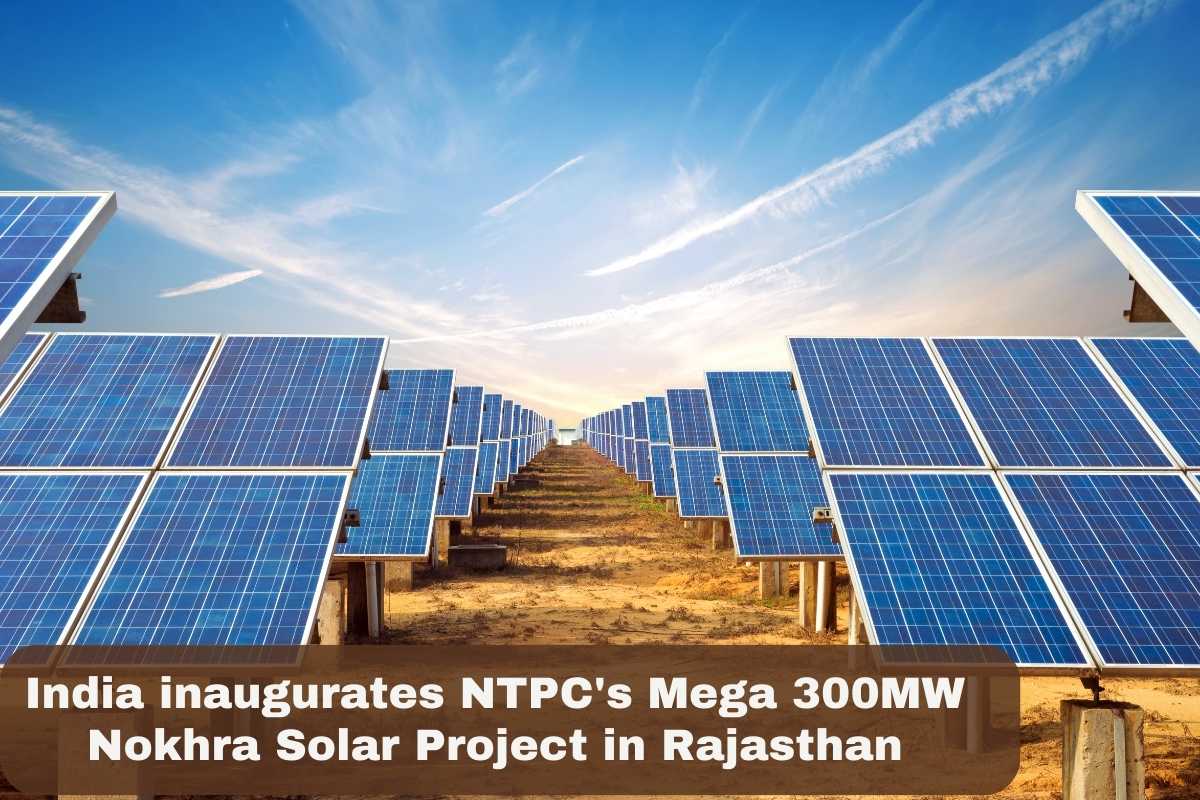


Nokhra Solar Project
The National Thermal Power Corporation (NTPC) is India’s largest power generation company, meeting about 25% of the country’s electricity needs. As part of India’s push towards renewable energy and sustainable development, NTPC has been diversifying its portfolio by significantly expanding its solar power generation capacity. One such major initiative by NTPC is the 300 MW Nokhra Solar Project in Rajasthan.
Inaugurated by Prime Minister of India on February 16, 2024, the Nokhra Solar Project is a significant milestone for NTPC and India’s renewable energy goals. With an investment of Rs 1,803 crore, the utility-scale solar photovoltaic (PV) project has added 300 MW of solar capacity to India’s grid. Built on 1,550 acres of land in Bikaner district, the Nokhra Solar Project will annually generate 730 million units of electricity to power over 1.3 lakh households.
NTPC’s Nokhra Solar Project
Overview of the Nokhra Solar Project
The 300 MW Nokhra Solar Project is located in Nokhra village, Bikaner district, Rajasthan. As a solar park project under the Ministry of New and Renewable Energy’s scheme, NTPC Green Energy Limited (NGEL), NTPC’s wholly-owned subsidiary focused on renewable energy, executed it.
Rajasthan’s high solar insolation and availability of non-agricultural land makes it an ideal state for large solar projects. The Nokhra site receives over 300 sunny days annually with high levels of horizontal solar irradiation, averaging over 5.5 kWh/m2/day.
Built under the Central Public Sector Undertakings (CPSU) Scheme Phase-II, the Nokhra Solar Project involved installation of over 13 lakh solar PV modules. The project is expected to generate 730 million units of solar power annually for the next 25 years.
Technical Aspects of Nokhra Solar Project
The Nokhra Solar Project utilizes crystalline silicon photovoltaic panel technology. Workers mount the solar panels on fixed structures angled towards the equator to maximize solar irradiation. Power generated from the solar panels, is transmitted to the grid through a pooling substation and connected transmission infrastructure.
The project applies the latest supervisory control and data acquisition (SCADA) systems and energy management solutions for remote monitoring, control and optimization. Advanced weather monitoring and forecasting provides solar power generation forecasts.
Environmental and Economic Impact of Nokhra Solar Project
As a zero-emissions energy source, the Nokhra Solar Project will offset over 15 million tonnes of carbon dioxide emissions over its 25-year lifetime. This contributes significantly to India’s climate change mitigation efforts and pledge to achieve 50% of installed power capacity from non-fossil sources by 2030.
The project created employment opportunities during construction and continues to provide skilled jobs in plant operations and maintenance. By providing renewable power, the project also reduces the nation’s expenditure on imported fossil fuels. The low-cost solar power can potentially save Rs 55,000 crore over the life of the project.
Challenges and Solutions
Land acquisition and infrastructure connectivity issues are key challenges for large solar parks like Nokhra. Effective coordination between central and state agencies ensured availability of contiguous land parcels. People invested in internal transmission infrastructure and grid integration solutions.
Maintenance of solar PV arrays in desert conditions requires innovative solutions like robotic dry cleaning technology for removing dust and sand deposits on panels. NTPC continues to focus on such technological innovations to maximize plant productivity.
The Role of NTPC in India’s Renewable Energy Sector
NTPC, India’s largest power generation company, has played a pivotal role in the country’s energy transition towards renewable sources. Founded in 1975 as a thermal power producer, NTPC has evolved to become a leader in renewable energy.
In 2020, NTPC established a wholly-owned subsidiary, NTPC Renewable Energy Limited (NTPC REL), with the objective of accelerating renewable capacity addition. Since then, NTPC REL has undertaken several major renewable energy projects across India.
Key renewable energy projects by NTPC REL include solar parks in Rajasthan, Gujarat, and Andhra Pradesh with capacities ranging from 40MW to 300MW. NTPC REL is also developing a 1.3GW solar park in the Rann of Kutch region and has won a bid to develop a 900MW solar project in Rajasthan.
Beyond solar, NTPC REL is investing in wind energy and green hydrogen production. It is working on a 1GW wind energy project in Karnataka and planning green hydrogen hubs in states like Andhra Pradesh.

Future of Solar Energy in India
India has tremendous potential for solar energy, receiving about 300 days of sunshine every year. Government estimates indicate 749GW of solar power potential assuming just 3% wasteland area utilization.
To leverage this, India has set a target of 175GW of renewable energy capacity by 2022, including 100GW of solar. Key policies like tax rebates, low-interest loans, and subsidies are accelerating solar adoption.
Several Indian states are undertaking massive solar projects, like the 2,245MW Bhadla Solar Park in Rajasthan. Rooftop solar is also gaining traction through net metering policies.
Going forward, India is expected to see continued growth in utility-scale and decentralized solar installations. Emerging innovations in solar paint, solar windows, floating solar farms etc. will further boost adoption.
International collaborations are enabling technology and knowledge transfer – for instance, NTPC REL is partnering with France’s Technip Energies for green hydrogen production. Such global cooperation will be vital for realizing India’s solar ambitions.
Conclusion
As one of India’s largest solar projects, the 300 MW Nokhra Solar Park takes the country closer to its sustainable development goals. Built entirely with indigenous solar PV components, the project stimulates the domestic manufacturing industry as well. Successful commissioning of utility-scale projects like Nokhra demonstrates India’s proficiency in building world-class solar infrastructure.